About P247
P247 is the decision layer for athletes who train with intent.
It is built for people training for HYROX, marathon, half marathon, Ironman, triathlon, cycling, ultra and hybrid events — athletes who already have plenty of data, but still need a clear call on what to do next.
P247 gives you a daily brief that explains itself and a weekly performance report that makes the decision.
Each day, the brief gives you a recovery score out of 100, shows which inputs moved it, and makes a call for the day. Each week, the report brings together the training and recovery data you connect, plus context you add yourself, and shows what is working, what is holding you back, and what to change next.
Not another wearable. Not a giant dashboard. Not a score you have to take on trust.
The problem
Athletes are drowning in numbers.
Your watch tracks sleep, HRV, resting heart rate, training load and recovery. Strava tracks pace, distance, power and effort. Nutrition apps track calories, protein and carbs. Body composition scans track muscle, fat and weight.
Each app tells part of the story. None of them knows the whole week.
Your Garmin may say productive. WHOOP may say recovered. Strava may show load rising. Your legs may feel heavy. Your nutrition may be patchy. Your next event may need a different type of session.
That is the gap P247 fills.
Professional athletes have coaches, physios and performance staff who review the full picture. Most serious recreational athletes do not. They guess, push through, overcorrect, or miss the pattern until it becomes a problem.
P247 turns the week into a decision.
What P247 gives you
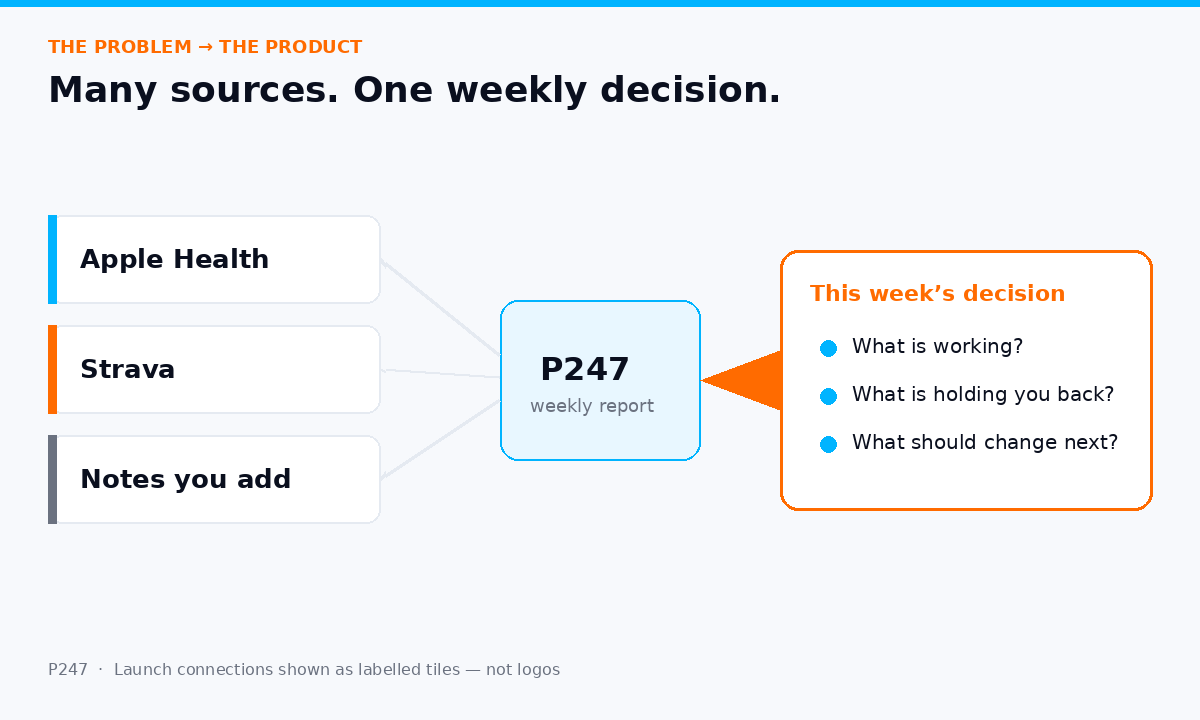
At launch, P247 connects to Apple Health (iOS / HealthKit) and, optionally, Strava. Data from wearables such as Garmin, WHOOP or Oura can reach P247 when those devices sync into Apple Health, or when activities land in Strava. You can also add context yourself — how you felt, soreness, nutrition notes, body-composition scans, travel or injury — because the week is never only what the watch recorded.
The weekly performance report answers three questions:
- What is working?
- What is holding you back?
- What should change next week?
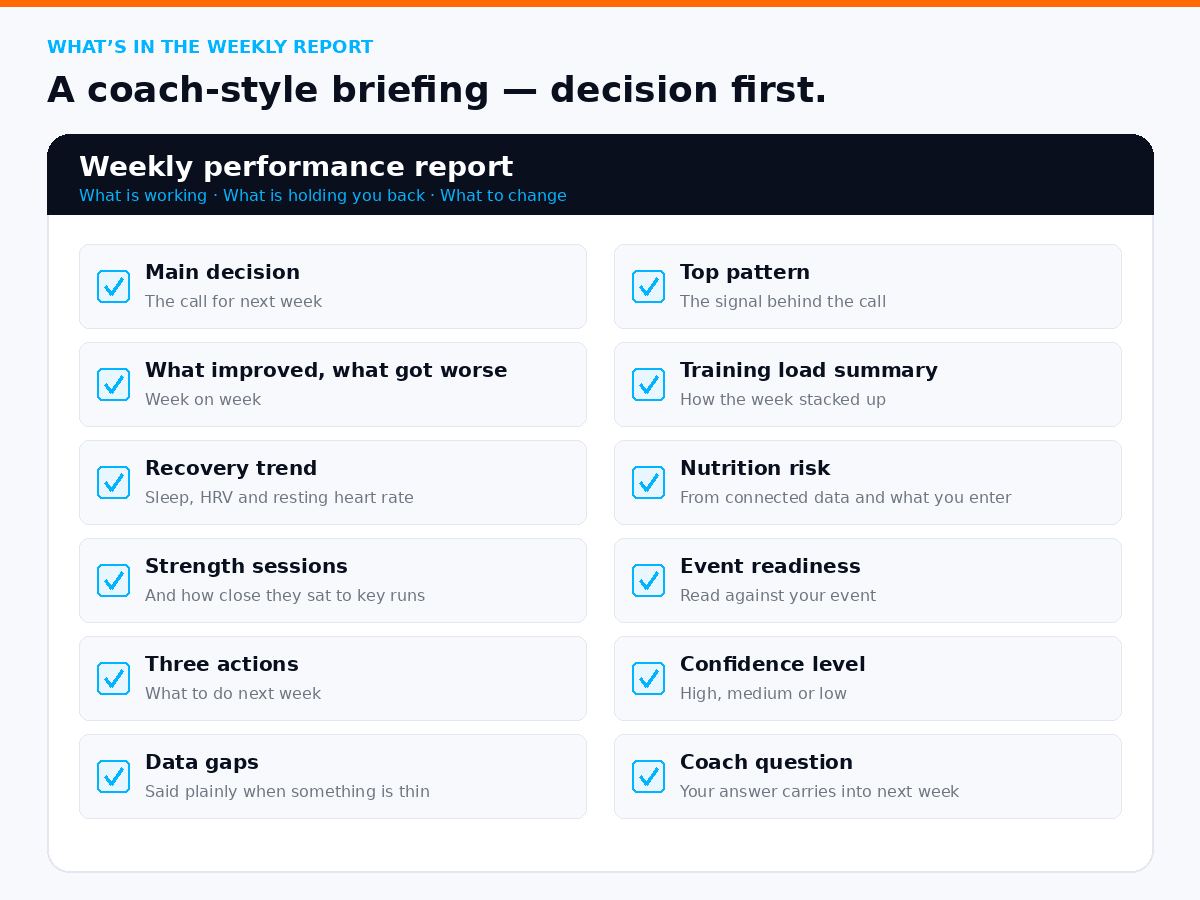
A report includes your main decision and the pattern behind it, what improved and what got worse, a training load summary, your recovery trend (sleep, HRV and resting heart rate), nutrition risk, strength sessions and how close they sat to your key runs, event readiness, three actions for the next week, a confidence level with any data gaps, and one coach question. Your answer to that question is carried into the next week’s report. Nutrition comes from what is already in your connected sources where available, and from what you enter yourself — P247 does not require a separate nutrition integration.
For a HYROX athlete, that might mean checking compromised running, grip fatigue, sled work and knee load.
For a marathon runner, it might mean whether to build, hold or protect recovery before adding more intensity.
For an Ironman athlete or cyclist, it might mean spotting accumulated fatigue across disciplines before it shows up as a bad session.
If you are losing weight, for any reason, it keeps training, recovery and fuelling in view, and the body composition screen tracks your scans so scale weight is not the only number you see.
Every day
The daily brief scores your recovery out of 100 from sleep (including deep sleep and how broken it was), HRV, resting heart rate and training load. It shows which of those moved the score and gives one call for the day: Push Today, Train Smart or Recovery Only. A single day can mislead, which is why the brief shows its working and the weekly report makes the bigger call.
Around the brief and the report
- Coach chat: ask about your own data. The coach reads your last two weeks of sleep, recovery, training, nutrition and body data, plus your events and any injury you have logged. You choose its tone.
- Goal plans: a dated plan of sessions for your goal, built around any injury you have logged. When your week changes, it proposes adjustments that you approve or reject.
- Body composition: log DEXA or InBody results, and smart-scale readings come in through Apple Health, so you can follow weight, body fat and lean mass over time.
- Heart-rate zones: five zones from your maximum, reserve or threshold heart rate, or copied in by hand from Strava. P247 can propose a maximum heart rate from your own recordings for you to accept.
- Sleep plan: set your wake-up times and get a bedtime and wind-down time for the coming nights, adjusted for your training load and recent sleep debt.
- Blood tests: scan a photo or PDF of your blood test results. P247 reads the markers, tracks them over time and gives a plain-English summary for training context. It is not a diagnosis or medical advice.
Why I built this
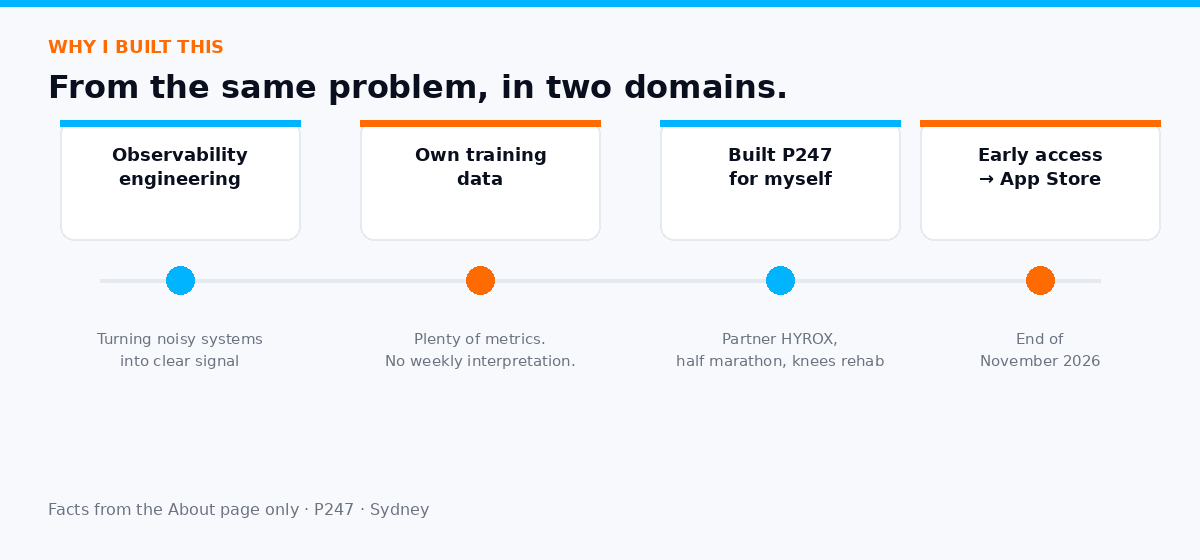
I’m Myles. I am 52, I train six days a week, and I am preparing for Partner HYROX with my wife and a half marathon later in the year.
My day job is in observability engineering. I help organisations make sense of complex data systems. Metrics, logs, traces, dashboards. Turning noise into signal. That is what I do professionally.
When I looked at my own training data, I saw the same problem in a different domain. I had plenty of metrics, but no clear weekly interpretation. I was still opening several apps and deciding by feel.
At 52, recovery matters more than ego. The margin between progress and injury gets thinner every year. I have been rehabbing both knees with my physio while still training consistently. That only works when training, recovery, load and life context are read together.
I built P247 because I needed it.
Now I am getting it ready for other athletes who train seriously but do not have a performance team behind them. P247 is in early access ahead of App Store launch at the end of November 2026.
Where P247 is going
The long-term goal is performance memory.
P247 should remember the decisions you made, what happened after, which patterns repeat, what load you tolerate, when you break down, and what worked last time.
That is what makes the report useful. Not generic advice. Not a score you have to take on trust. A system that gets sharper as your training history grows.
Your data, your control
P247 handles sensitive health data. We take that seriously.
Your data is encrypted in transit (HTTPS). We do not sell it, we do not use it to train public AI models, and we do not share it with advertisers. Some features, such as coach chat and blood test reading, send the data they need to an AI provider, and the app asks for your permission first. You can delete your account in the app and request an export of your data from privacy@p247.io.
Health data is only collected with your permission. P247 reads from connected apps and does not write back to them. Full details are in our Privacy Policy.
We comply with the Australian Privacy Act 1988, GDPR, UK GDPR and CCPA.
The company
P247 is built and operated by Commit-IT (ABN 60 137 471 615), based in Sydney, Australia.
Questions? Reach us at hello@p247.io.
P247 is in early access. Join the waitlist to get access ahead of the App Store launch at the end of November 2026.
P247 is in early access ahead of App Store launch at the end of November 2026.
Join the Waitlist →