If you are training for HYROX without a SkiErg, the useful question is not “what makes me breathe hard?” It is “what trains the same pull pattern the machine asks for?”
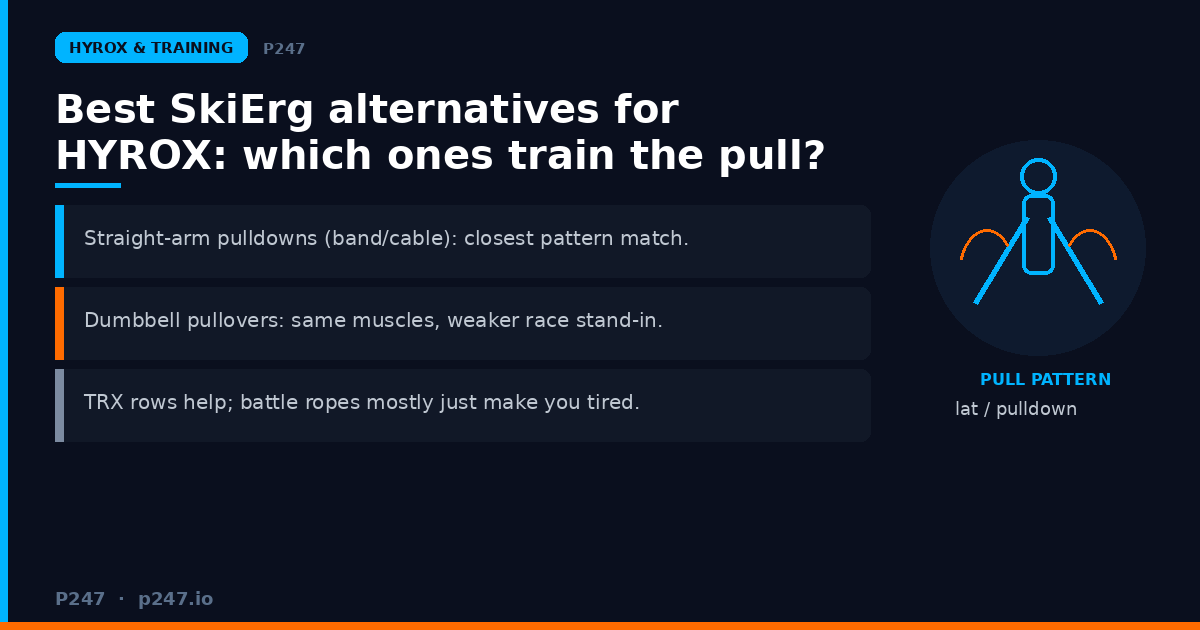
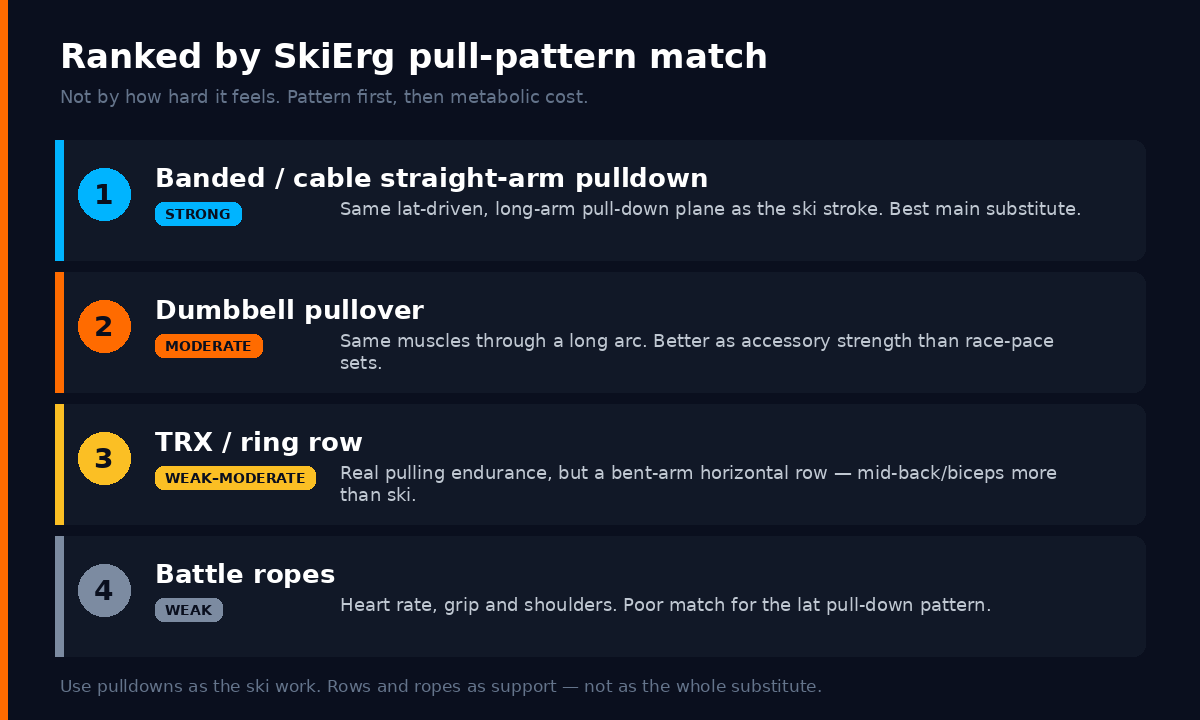
Short answer, ranked by how closely each one matches the SkiErg pull:
- Banded or cable straight-arm pulldowns — closest. Same lat-driven, long-arm pull-down pattern.
- Dumbbell pullovers — same muscles through a long arc, less vertical, harder to load as high-rep endurance.
- TRX or ring rows — a real pull, but a bent-arm horizontal row. Mid-back and biceps more than a ski pull.
- Battle ropes — great for grip, shoulders and heart rate. Poor match for the lat pull-down pattern.
None of them is a perfect copy. That is fine. You are trying to arrive at the race station with the right strength and rhythm, not to cosplay the machine in your gym.
For a full no-SkiErg session you can drop into a HYROX week, use the companion guide: No Ski Erg? How to Train for the HYROX SkiErg Without the Machine. This post is the comparison that sits behind that session.
What the SkiErg pull pattern actually is
A HYROX ski station is not “arms until you are cooked.”
Each stroke is a hip hinge into a long-arm pull. The handles start high, your lats and triceps drive them down toward your hips, your trunk braces so the force does not leak into a floppy lower back, and you have to keep that rhythm after you have already been running. Breathing has to stay organised or the strokes get short and expensive.
So the pattern you are trying to train is closer to a straight-arm pulldown than to a chin-up, a bent-over row or a rope slam. If a substitute loads the lats through a long arm and asks you to repeat it under fatigue, it is doing useful ski work. If it only spikes your heart rate or smashes your grip, it is conditioning — useful, but not the same thing.
Banded or cable straight-arm pulldowns: the closest match
This is the one I would keep if I could only keep one.
A band anchored high, or a cable set high, with straight (or nearly straight) arms pulling the handles from overhead toward the hips, is the same plane and the same primary movers as the ski stroke. You can do it for high reps. You can put it straight after a run. You can breathe through it the same way you would on the erg.
Cables are smoother and easier to load precisely. Bands travel well and still hit the pattern. Either beats a random upper-body finisher when the goal is ski prep.
Honest limit: there is no flywheel. The SkiErg fights you through the whole stroke in a way a band or cable does not perfectly copy. You are training the pattern and the local endurance, not the exact machine feel.
Dumbbell pullovers: same muscles, different setup
Lying pullovers take the lats through a long stretch-to-shorten arc. That is the right tissue. The hinge and trunk demand are different because you are on a bench, and it is harder to turn into the kind of continuous, breathing-led set the ski asks for.
Use them as accessory strength: controlled tempo, full range, not a race-pace circuit. They build the muscles that drive the stroke. They are a weaker stand-in for the station itself than pulldowns.
TRX and ring rows: a pull, but not that pull
High-rep TRX or ring rows are popular “no SkiErg” suggestions, and they are not useless. They train pulling endurance, scapular control and the ability to keep moving under fatigue. For hybrid athletes who do not row or pull much elsewhere, that matters.
But a row is a bent-arm, roughly horizontal pull. A ski stroke is a long-arm, roughly vertical pull-down. Different plane, different emphasis. Rows hit mid-back and biceps harder; the ski hits lats and the long pull-down more.
Keep TRX rows in the mix as accessory work. Do not pretend they are the ski.
Battle ropes: mostly metabolic, not the pattern
Battle rope slams and waves will raise your heart rate, tax your grip and shoulders, and leave you breathing hard. That can sit usefully in a hybrid session. It does not train the lat pull-down pattern the SkiErg uses.
If your only “ski substitute” is ropes, you are practising being tired with your arms. You are not practising the stroke. Use ropes as conditioning, then do something that actually pulls.
Quick ranking
| Substitute | Pull-pattern match | Best use |
|---|---|---|
| Banded / cable straight-arm pulldown | Strong | Main ski substitute, including after running |
| Dumbbell pullover | Moderate | Accessory lat strength |
| TRX / ring row | Weak–moderate | Pulling endurance accessory |
| Battle ropes | Weak | Metabolic / grip conditioning |
How to use this without reinventing the session
The companion guide already has a simple weekly session: run into pulldowns, swings and a farmer carry, with a short breathing reset between rounds. That is the structure. This post is only about picking the right pull.
Practical rules I actually use:
- Put the closest pattern first. If you have bands or a cable, straight-arm pulldowns are the ski work. Everything else is support.
- Train it after running sometimes. The race station sits after a run. Fresh pulldowns teach strength. Fatigued pulldowns teach race rhythm.
- Do not confuse hard with specific. Ropes and thrashy circuits can feel more like HYROX and still miss the pull you need on race day.
- Watch the limiter. If your lower back quits before your lats, the hinge and brace need work. If grip dies and the rest of the session falls apart, that is useful information for the week, not a reason to only do ropes.
The point
For HYROX ski prep without the machine, banded or cable straight-arm pulldowns are the best pattern match. Pullovers build the same muscles. TRX rows help as a different kind of pull. Battle ropes make you tired.
Train the demand, not the vibe. Then put that pull into a session that also asks you to run, brace and breathe — the full version is in the no-SkiErg HYROX training guide.
HYROX weeks are messy even with perfect kit. Without a SkiErg, the decision quality matters more: which limiter are you actually training this week, and is the fatigue you are carrying useful or just noise? P247 reads the training and recovery data your devices put into Apple Health, plus Strava if you connect it, and turns that into a daily brief and a weekly report you can act on. The AI coach is there if you want to talk a decision through.
P247 is available now on the App Store, with Android to follow in 2027. Get it here.
P247 is available now on the App Store. Connect Apple Health and get your first weekly performance report free.