
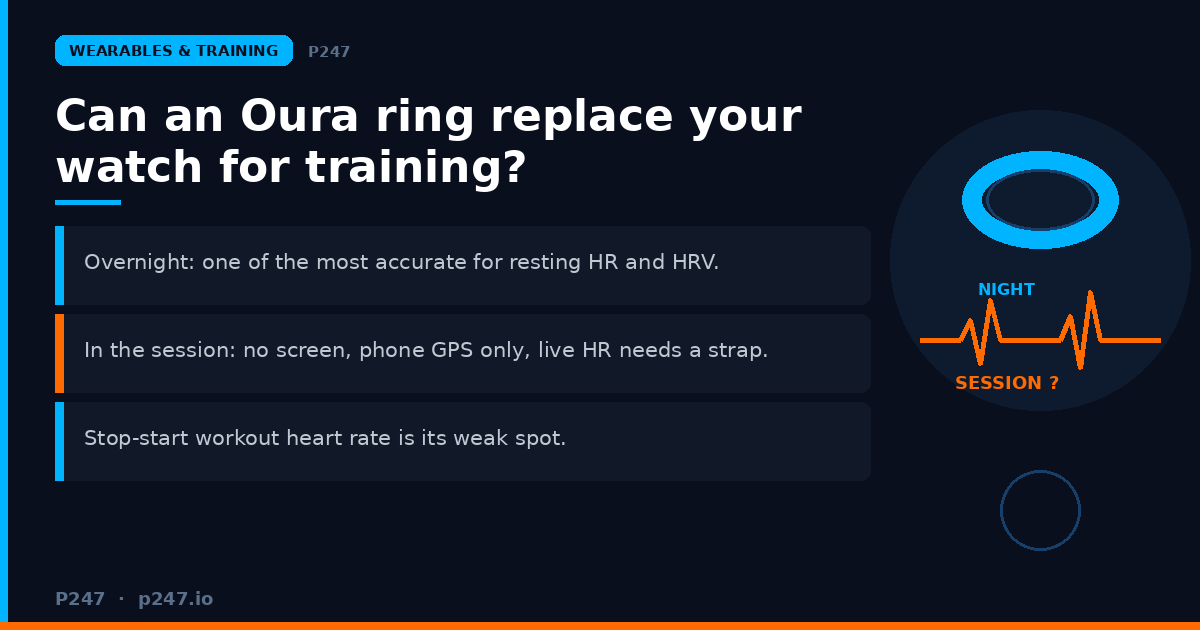
If you are thinking about swapping your watch for an Oura ring, the honest answer for most endurance and hybrid athletes is: not completely.
Oura is very good at the part of the day when you are lying still. It is much weaker at the part where you are training.
- Overnight, it is one of the best. In a 2025 validation study, Oura had the closest agreement with an ECG chest strap for overnight resting heart rate and HRV of the five wearables tested.
- In the session, it is not a training watch. There is no screen, the ring has no GPS of its own, and live heart rate during a workout needs a separate chest strap or other heart rate monitor.
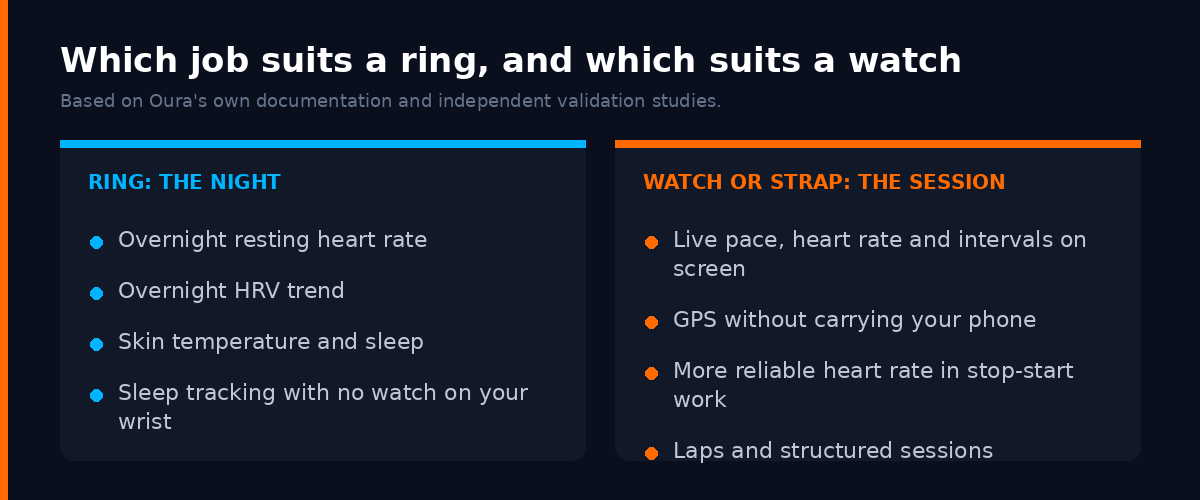
- Workout heart rate is less reliable. Independent testing found larger heart rate errors for the ring than for most wrist devices, especially when movement was stop-start.
So the useful question is not “ring or watch?” It is “which job does each device do?” For a lot of athletes, the answer ends up being both, or a ring plus a chest strap.
I wear an Apple Watch, not an Oura ring, so this is not a long-term user review. It is what Oura’s own documentation and the independent research say, read from the point of view of someone who trains for HYROX and a half-marathon.
What Oura is genuinely good at
Oura’s strength is overnight data. Resting heart rate, HRV and skin temperature are all measured while you sleep, when you are still and the sensor has a good, steady signal. Its Readiness score is built from those overnight signals plus your sleep and recent activity.
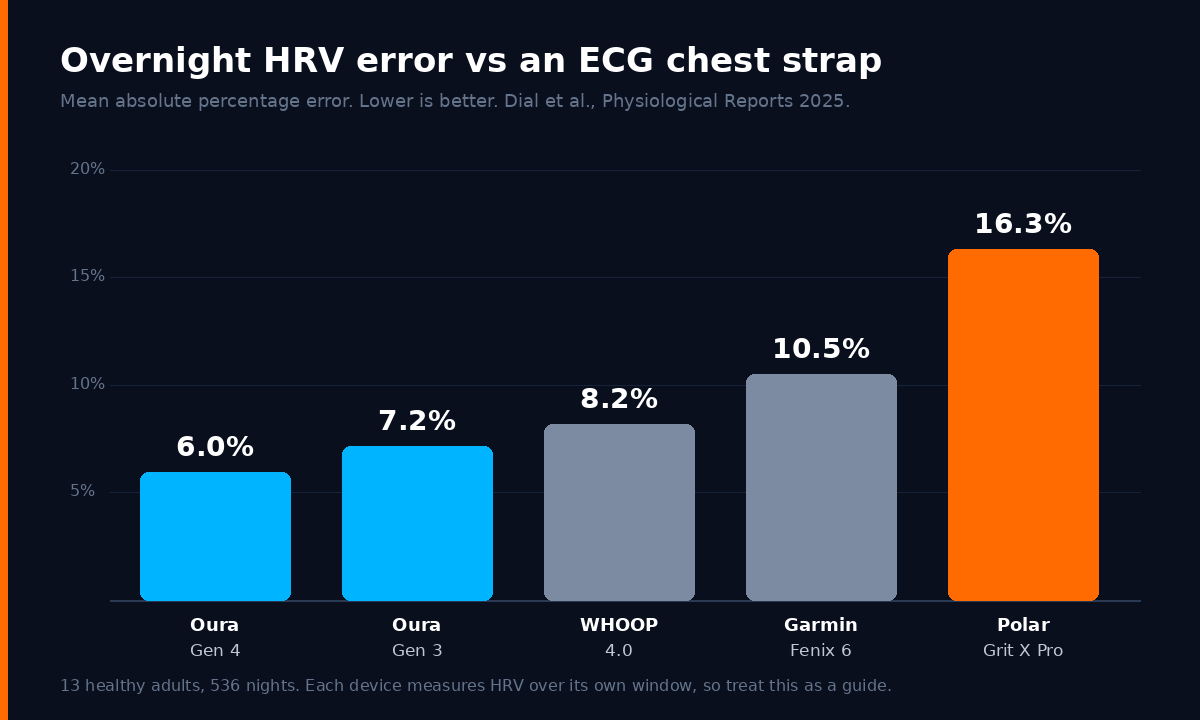
The best independent evidence here is Dial and colleagues in Physiological Reports (2025). Thirteen healthy adults wore an ECG chest strap and several wearables at the same time while they slept, for a total of 536 nights. The devices were Oura Gen 3 and Gen 4, WHOOP 4.0, a Garmin Fenix 6 and a Polar Grit X Pro.
For overnight HRV, the average percentage error against the ECG was:
- Oura Gen 4: about 6.0%
- Oura Gen 3: about 7.2%
- WHOOP 4.0: about 8.2%
- Garmin Fenix 6: about 10.5%
- Polar Grit X Pro: about 16.3%
Oura also had the highest agreement for resting heart rate. The authors’ summary was that Oura showed the highest agreement for both, WHOOP was acceptable, and the Garmin and Polar watches were lower.
Before anyone screenshots that chart as a winner’s podium, the caveats:
- Thirteen people is a small group, even with a lot of nights.
- Each device calculates HRV in its own way and over its own window. A letter to the editor pointed out that WHOOP’s HRV is weighted towards a particular part of the night but was compared with an all-night average from the chest strap, which may have made WHOOP look worse than it is. The Garmin was left out of the resting heart rate comparison for a similar reason.
- The watches tested were not the newest models, and firmware changes over time.
Even with those caveats, the direction is clear: if what you care about most is a clean overnight resting heart rate and HRV trend, a ring is a very good tool for it.
Where a ring falls short for training
This is where the “replace your watch” idea runs into trouble. None of the following is a criticism of Oura. It is just not what a ring is built to do.
There is no screen. You cannot glance down at your pace, heart rate, lap time or interval count. For a threshold run, a structured bike session or a HYROX simulation where you are holding a target, that matters.
The ring has no GPS of its own. Oura’s own support pages say you need your phone on you, with location services on and the Oura app running in the background before you start, to get route, distance, pace and splits. Leave the phone at home and the ring still records the session, but without the route and pace.
Live heart rate needs another device. Oura’s Live Activity Tracking shows live pace and distance from your phone’s GPS. For live heart rate during a workout, Oura says you need a compatible external heart rate monitor such as a chest strap, and that the ring does not stream live heart rate to your phone’s screen. The ring still records heart rate during the activity and shows it afterwards.
Workouts are detected, not planned. Oura’s Automatic Activity Detection uses the ring’s accelerometer to suggest the type, time, duration and intensity of an activity. It needs at least 10 minutes of activity, and you confirm or edit it afterwards. That is fine for counting movement. It is not the same as recording a structured session with laps and intervals.
What the research says about workout heart rate
The ring is a lot less impressive once you start moving.
A 2026 validation study from KU Leuven tested ten consumer wearables against an ECG chest strap. The protocol was rest, a mental stress task, steady treadmill walking and stop-start walking, in neutral, hot and cold rooms. Across the whole protocol, the Oura Gen 3 had a median heart rate error of about 11 bpm, or 15%. The Apple Watch SE, Garmin Vivoactive 5 and Google Pixel Watch 2 were all around 5 bpm. The authors grouped Oura with the devices that showed larger errors and wider limits of agreement.
There is also a small conference study from the Japan Institute of Sports Sciences (2025) that compared an Oura Gen 3 with a Polar H10 chest strap. It found close agreement during an incremental treadmill run, but much weaker agreement during cycling and weight training. The author’s conclusion was that the ring struggled to capture rapid heart rate changes in intermittent exercise. That study had one participant, so it is a hint, not proof.
Put those together and the pattern makes sense. Steady efforts are easier for any optical sensor. Stop-start work is harder. The KU Leuven authors also suggested that a finger is a harder place to measure, with a smaller contact area and blood flow that changes easily. Stop-start, grip-heavy work is exactly what HYROX gives you: sled pushes and pulls, farmers carries, wall balls and rowing, with running in between.
If heart rate during your HYROX sessions or bike intervals matters to you, a ring on its own is not the tool I would trust for it.
Who a ring alone could work for
There are athletes for whom a ring really can be enough:
- You train by feel or by pace, and you do not use heart rate zones during sessions.
- You run with your phone anyway, so the phone’s GPS gives you pace and distance.
- You mainly want recovery and sleep data, and you hate sleeping in a watch.
- You already own a chest strap and are happy to pair it for the sessions where heart rate matters.
And there are athletes for whom it will probably frustrate you:
- You do structured intervals and need to see pace, power or heart rate in the moment.
- You do a lot of stop-start or grip-heavy work, like HYROX, CrossFit-style sessions or heavy lifting, and want accurate heart rate for it.
- You race with a target pace or heart rate and need it on your wrist.
What I would actually do
If I were starting from scratch and wanted Oura’s overnight data, I would not treat it as a watch replacement. I would treat it as the overnight half of a pair.
Ring for the night, watch or strap for the session. Wear the ring for sleep, overnight HRV and resting heart rate. Use a watch, or a chest strap paired to your phone or a bike computer, for anything where in-session numbers matter.
Pick one source for each metric. If you wear a ring and a watch, they will give you two different HRVs and two different resting heart rates, because they measure at different times and in different ways. Do not average them and do not flip between them. Choose the ring for overnight numbers and the watch or strap for workout numbers, and compare each against its own history. I have written more on this in Oura vs WHOOP vs Garmin: three scores, zero context.
Remember what the readiness score does not know. A good Readiness score does not know you have a key interval session planned, or that yesterday’s 90 minutes on the SkiErg was harder than the ring thought. That is why I keep saying readiness is useful until training context changes the answer.
The point
An Oura ring is not a worse watch. It is a different tool. It is one of the better ways to get clean overnight resting heart rate and HRV, and one of the weaker ways to measure what happens inside a hard, stop-start session.
If you train seriously, the question is not whether to give up your watch. It is whether you want better overnight data alongside it.
Whichever way you go, the numbers still need reading together. P247 reads the data your devices already put into Apple Health, and Strava as well if you connect it. Oura can share data to Apple Health, so a ring and a watch can both feed the same picture. Each morning there is a daily brief with a recovery score built from your own trends, and each week a report for the bigger calls: what is working, what is holding you back, and what to change. If you want to talk a choice through, you can ask the AI coach.
Your first report is free. P247 is available now on the App Store, with Android to follow in 2027. Get it here.
P247 is available now on the App Store. Connect Apple Health and get your first weekly performance report free.