
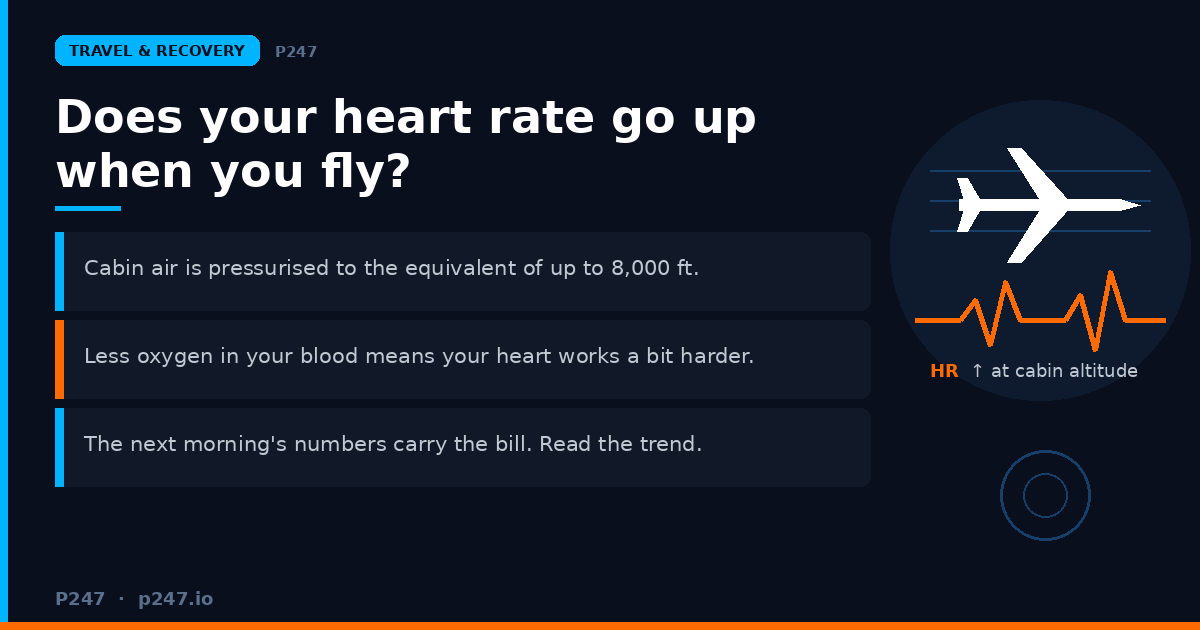
If you have ever glanced at your Apple Watch halfway through a flight and seen a heart rate that looks more like a slow jog than sitting in seat 34C, you are not imagining it.
The short answer: yes, your heart rate usually goes up when you fly. Not dramatically for most healthy people, but enough to notice, and enough to mess with your numbers the next morning.
- The cabin is not at sea level. Planes are pressurised to the equivalent of a moderate altitude, up to 8,000 ft (about 2,400 m). Your blood carries a bit less oxygen, and your heart works a bit harder to make up for it.
- Alcohol adds to it. In a 2024 sleep study at simulated cabin altitude, a couple of drinks pushed sleeping heart rate up much further and oxygen levels down further than altitude alone.
- The bill arrives the next morning. Short, broken sleep, time zones and the stress of the travel day all land in your resting heart rate, HRV and recovery score after you get off.
None of this means you are getting sick. It does mean the morning after a flight is a bad day to let a single score decide your training.
I have already written about why resting heart rate rises before you even leave. This post is about the flight itself, and the day or two after.
What the cabin actually does to you
Aircraft cabins are pressurised, but not to sea level. The US certification rule for airliners, 14 CFR 25.841, requires a cabin pressure altitude of no more than 8,000 feet under normal operating conditions. The World Health Organization’s International Travel and Health guidance puts the typical range at the equivalent of 1,800 to 2,400 m (6,000 to 8,000 ft).
That is roughly like spending the flight sitting on a mountain. Not a big one, but high enough that the air at that pressure pushes less oxygen into your blood.
The best-known study on this is Muhm and colleagues in the New England Journal of Medicine in 2007. They put 502 adult volunteers through a 20-hour simulated flight in a hypobaric chamber at pressures matching ground level up to 8,000 ft. Average blood oxygen saturation fell as the simulated altitude rose, by about 4.4 percentage points at 8,000 ft. That was not enough to change how often people got acute mountain sickness, but reports of discomfort rose at 7,000 to 8,000 ft, and the differences showed up after 3 to 9 hours.
When oxygen saturation drops, a faster heart rate is one of the ways your body keeps oxygen moving to your tissues. That is the main reason the number on your wrist climbs at cruising altitude.
What the research shows about heart rate
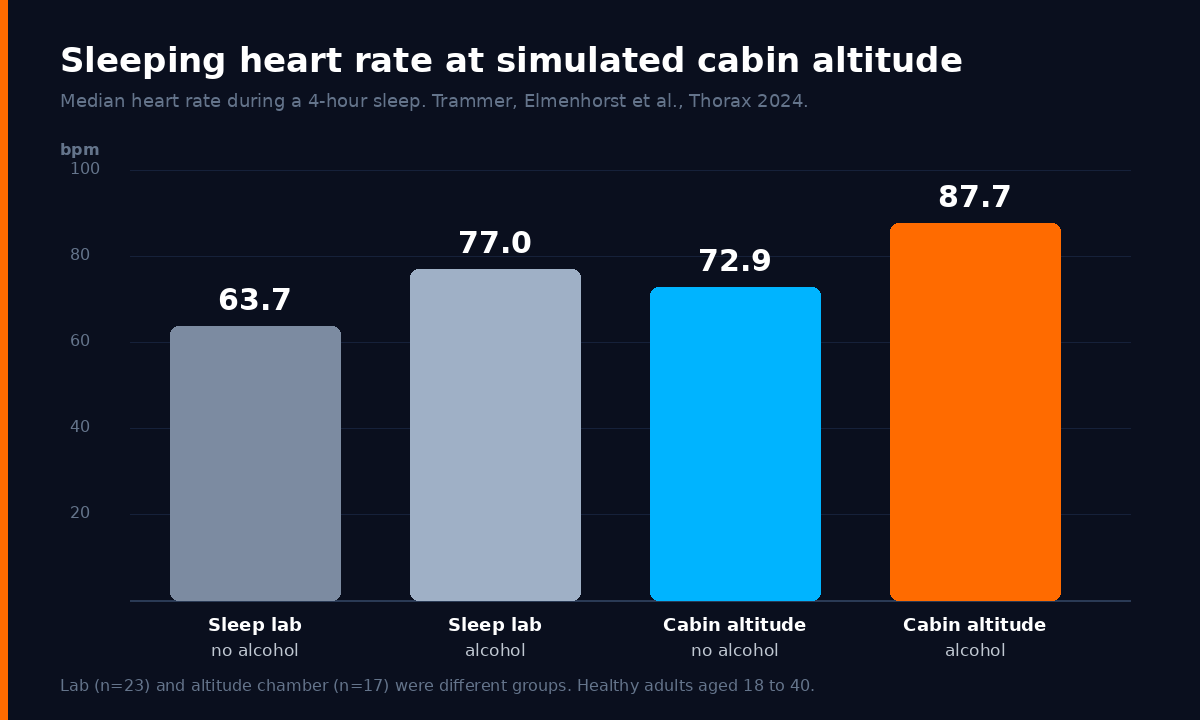
The most useful recent study for athletes came from the German Aerospace Center’s Institute of Aerospace Medicine, published in Thorax in 2024. Healthy adults aged 18 to 40 slept for four hours, either in a normal sleep lab or in an altitude chamber set to the cabin pressure of a plane at cruising altitude (2,438 m). Each person did one night after a moderate dose of alcohol and one night without.
Median heart rate during sleep:
- Sleep lab, no alcohol: 63.7 bpm
- Altitude chamber, no alcohol: 72.9 bpm
- Sleep lab, alcohol: 77.0 bpm
- Altitude chamber, alcohol: 87.7 bpm
Oxygen saturation followed the same pattern in the other direction. At simulated cabin altitude without alcohol, people spent a median of about 173 minutes of the four hours below 90% saturation. With alcohol it was about 201 minutes. In the sleep lab it was zero either way. Deep sleep was also shorter under the combined exposure than in either sleep lab condition.
Before you take those numbers too literally, the honest caveats:
- It was a chamber, not a plane. No engine noise, no cramped seat, no time zones, no airport.
- The sleep lab and the chamber were two different groups. 23 people in the lab and 17 in the chamber. The alcohol comparison was within each person, but the altitude comparison was between groups.
- They were young and healthy. The researchers said the effects might be larger in older passengers and people with existing medical conditions. I am 52, so I read that line twice.
- It was four hours of sleep, not a long-haul flight.
So I would not quote “flying adds nine beats” at anyone. What the study does show clearly is the direction: cabin altitude on its own raises sleeping heart rate and lowers oxygen saturation, and alcohol stacks on top of it.
It is not just the altitude
The cabin pressure is the part people do not think about, but it is rarely the only thing going on during a flight day:
- Caffeine to get through an early start or a red-eye.
- Alcohol in the lounge or with the meal. See above.
- Short or broken sleep, either the night before an early flight or upright in a seat.
- Stress. Queues, delays, connections, and if it is race travel, the race itself.
- Hours of sitting, plus meals at odd times.
What about dry air? Cabin humidity is low. WHO says it is usually under 20%, compared with over 30% in most homes. But WHO’s guidance also says low humidity may cause dry skin, eyes, mouth and nose and “presents no risk to health”. So I would not blame “dehydration from the plane” for a big jump in heart rate. I still drink water on a flight, because I would rather not stack mild dehydration on top of everything else, but it is not the main story.
The point is that your watch sees one number. It cannot tell you how much came from the cabin, how much from the second coffee and how much from the stress of a missed connection.
What it does to your next morning’s numbers
This is where flying causes problems for training decisions.
The flight itself is usually not where the damage shows. It is the next morning, when you check your resting heart rate, HRV or recovery score and it looks like you have been run over. A higher resting heart rate, a lower HRV and a poor sleep score after a flight are normal responses to a hard day, not proof that you are ill or have lost fitness.
If you have crossed time zones, it gets messier. Your sleep is shifted as well as short, and your body clock is out of step with local time. A study by Fowler and colleagues followed ten trained men flying 21 hours between Australia and Qatar. Travelling east (the trip home to Australia) hit sleep, jet lag, fatigue and motivation harder than travelling west, and sprint performance was worse in the first 72 hours after the eastward trip. Whichever way they flew, maximal sprint and jump performance were still down up to three or four days after arriving.
That is a small study in team-sport athletes, not endurance athletes. But the lesson carries over: the cost of a long flight shows up in the days after you land, not just on the plane. I covered the time-zone side in more detail in your recovery score doesn’t know you just flew across seven time zones.
How I train around a flight
Nothing here is clever. It is just a way of not letting a flight-shaped number drive a training decision.
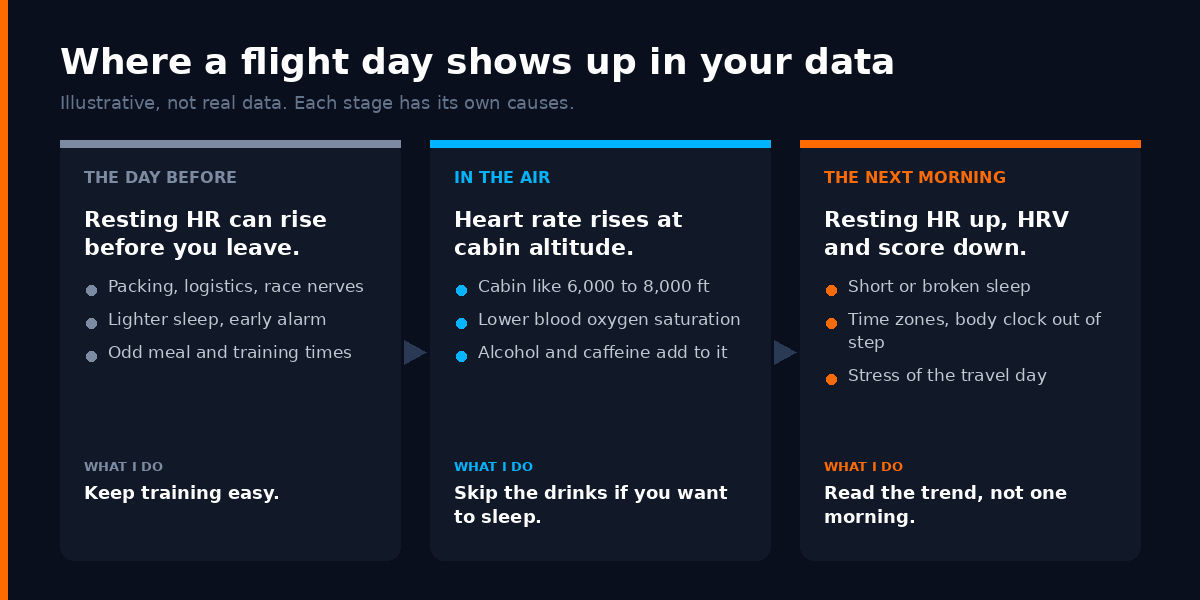
Flight day is not a key session day. If I can train before an afternoon flight, it is an easy run or ride, or some mobility. I do not try to squeeze in a HYROX simulation or a threshold session before heading to the airport.
Go easy on alcohol, especially if you plan to sleep. The Thorax study is the clearest reason I know. If I want to sleep on a long flight, I would rather skip the drinks entirely.
Treat the first morning’s numbers as context, not a verdict. A higher resting heart rate and lower HRV the morning after a flight is what I expect. I look at the trend over the next few days instead. If my numbers are heading back towards normal by day two or three, that is the flight wearing off.
Let a known effort decide. The first easy session after landing tells me more than any score. If my normal easy pace feels normal at a normal heart rate, I am fine. If it feels much harder than it should, that day stays easy.
For race travel, plan the gap. I do not want a long-haul flight landing the day before a race I care about. For a domestic flight with no time-zone change, I want at least a proper night’s sleep in between. For a long-haul trip, the Fowler study is a good reminder that the effects can last several days.
When it is not just the flight
A higher heart rate in flight is normal. These are not:
- Chest pain, a racing or irregular heartbeat that does not settle, fainting, or real shortness of breath.
- A resting heart rate that stays well above your normal for days after you land, especially with a sore throat, a temperature or feeling flat.
- Calf pain or swelling after a long flight.
If you have any of those, get medical advice rather than reading your watch. And if you have a heart or lung condition, talk to your doctor before a long flight. WHO’s guidance specifically says some passengers with heart, lung and blood conditions may not tolerate the reduced oxygen well. This post is not medical advice.
The point
Your heart rate going up on a plane is not your watch being broken, and it is not your fitness disappearing. It is your body responding to a day at altitude, often with caffeine, alcohol, stress and bad sleep on top.
The mistake is reading the next morning’s data as if it were a normal day. The same resting heart rate and HRV mean something different the morning after a flight than they do in a normal training week.
That is the gap I built P247 for. It reads the data your watch already records in Apple Health, and Strava as well if you connect it. Each morning there is a daily brief with a recovery score, built from your own trends, and each week a report for the bigger calls: what is working, what is holding you back, and what to change. A flight-day dip is one bad morning inside a week of training, and it should be read that way. If you want to talk it through, you can tell the AI coach you have just flown and ask how to adjust the next few days.
Your first report is free. P247 is launching on the App Store at the end of November, with Android to follow in 2027. If you want in early, join early access here.