
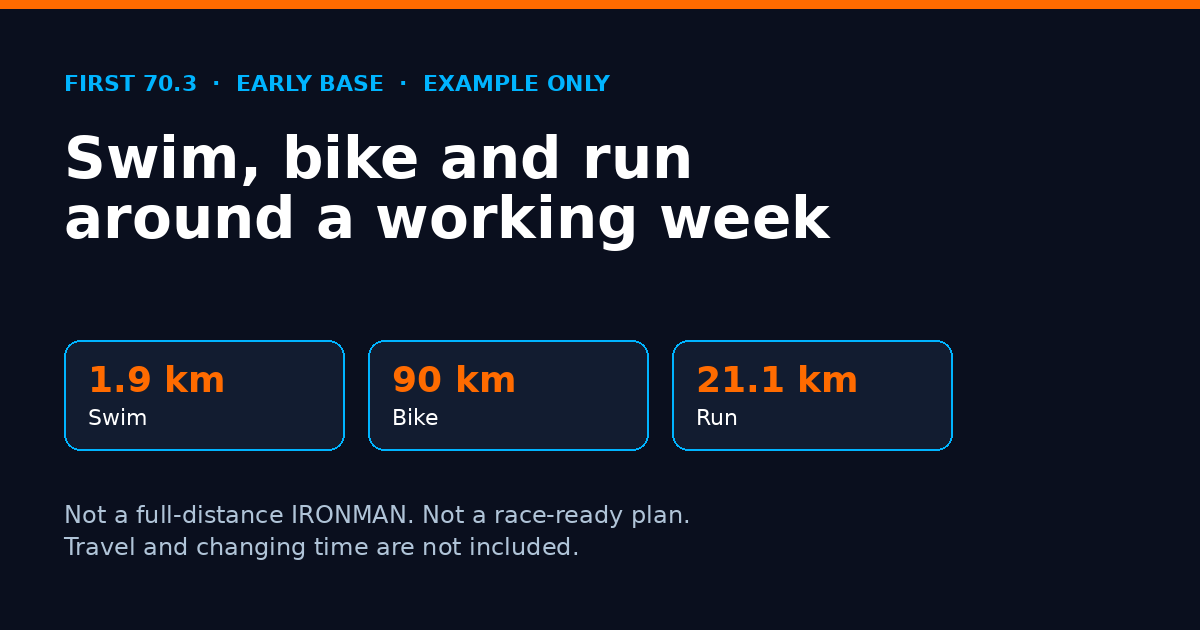
An IRONMAN 70.3 is a 1.9 km swim, a 90 km bike and a 21.1 km run, about 113 km in total. A full-distance IRONMAN is twice those pieces: 3.8 km, 180 km and 42.2 km. This page is about fitting a first 70.3 into a working week. It is not a full-distance plan, and it is not a promise you will be ready on a particular date.
Short answer: start from the week you actually have. Work, the pool timetable, travel, daylight and sleep come first. Then place swimming, cycling and running you already tolerate, and leave a full rest day. Do not begin from a professional athlete’s volume, and do not give up sleep to tick every box. The table further down is an editorial example of organising an existing base. It is not your race plan.
The distances are the ones IRONMAN publishes for athletes getting started at 70.3, alongside the full-distance comparison (IRONMAN: your first 70.3). Nothing here is an official programme, and P247 is not affiliated with the event.
Who this example is for
This is for someone preparing for a first race at this distance, not their first week of exercise. The phase is early base: become consistent, keep the work mostly easy, and learn the sports. It is not peak race-specific training, a taper, or a complete path to the start line.
IRONMAN’s own 16-week 70.3 guide assumes you already have an aerobic base and are comfortable swimming, cycling and running, and it says people who are new to endurance or returning after a layoff will usually need longer (16-week guide). Sixteen weeks is a framework on that page, not a deadline that fits everyone. This article does not copy that plan’s long rides, intensity percentages, or equipment progressions.
You need to bring a few things before the example week is even relevant. Several recent weeks of activity you tolerate in all three sports. Safe pool swimming. Bike handling you can trust on the roads or paths you actually use. A runner is not automatically a triathlete. If you are new to swimming, or not confident in the water, book qualified instruction. Do not chase a time target from this page.
The imaginary athlete in the table is healthy, has recently been comfortable at roughly six to seven hours a week across all three sports, can handle the session lengths shown, rides safely, and can use a supervised pool. Those are assumptions for the illustration, not a test you have passed. If they are not you, use less, and get a coach or an instructor who can see you. Do not jump to this load because a table made it look tidy.
Audit the week you have
Write down the constraints before you write down the sessions.
- When you work, including shifts, and when you are actually finished rather than theoretically finished.
- Commute, family, and the time to shower and change. The hours below do not include that.
- When the pool is open, and whether a coached lane exists.
- Daylight, weather, and a cycling route you can ride safely. A trainer session is not the same skill as riding outside.
- The kit you already own. This page does not add a shopping list.
Put sleep and one full rest day on the calendar before you add an optional extra. If the hours you have cannot hold the preparation the event needs, the honest move is to change the race date or the goal with a qualified coach. Raising intensity to force it into a short week is how people get hurt or simply stop.
An example of organising an existing base
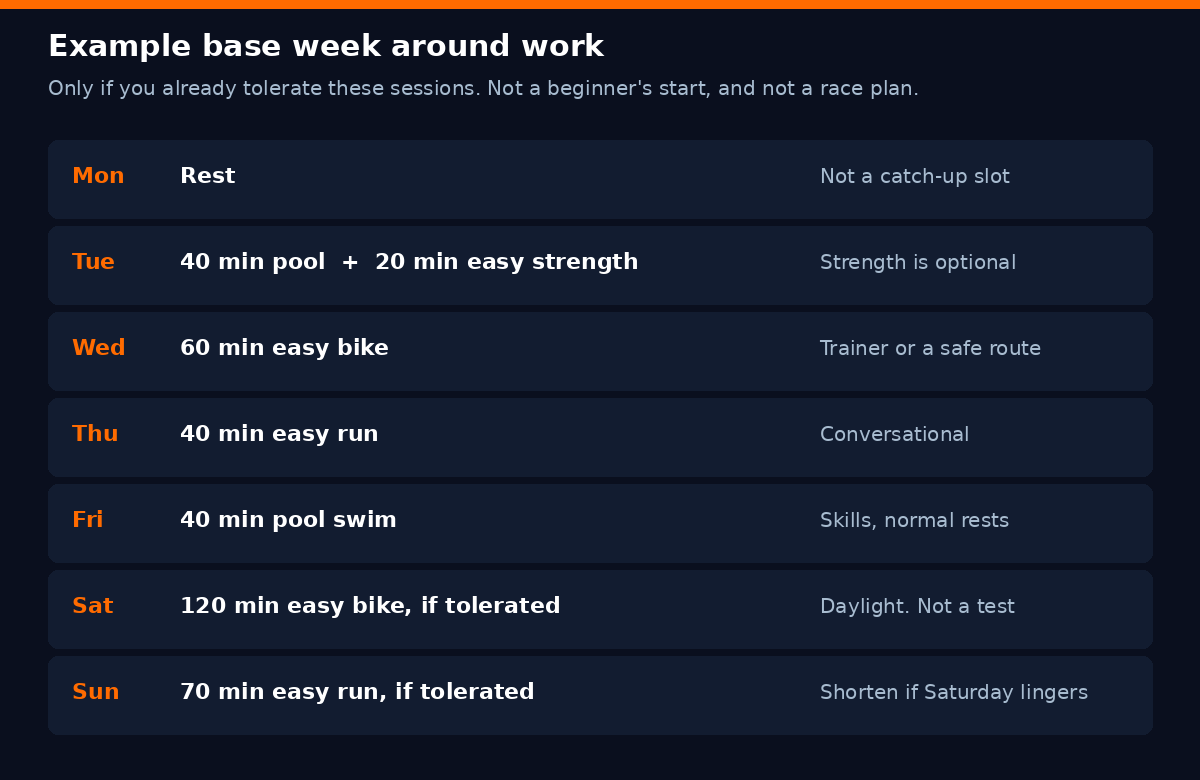
An example of organising an existing base, not a beginner’s first week and not a race-ready plan. Every duration below is “only if you already tolerate something like it”. If you do not, keep your current session length. The point of the table is the order and the reason, not the minutes.
| Day | Example session | Why it sits there |
|---|---|---|
| Monday | Full rest | Recovery. Not a slot for the session you missed. |
| Tuesday | 40-minute pool swim, coached or otherwise appropriate, plus 20 minutes of familiar light strength or mobility | Use a lane you can actually get. The strength is optional, and it is not new heavy lifting. |
| Wednesday | 60-minute easy bike | Trainer or a safe route. Indoor fitness does not stand in for outdoor handling. |
| Thursday | 40-minute easy run | Conversational. Not a new hard run added so the week looks “balanced”. |
| Friday | 40-minute pool swim | Skill practice inside what you can already do, with normal rests. No breath-hold sets. |
| Saturday | 120-minute easy bike, only if you already tolerate it | A daylight block you can protect. Practise the eating and drinking you will need later. It is not a fitness test. |
| Sunday | 70-minute easy run, only if you already tolerate it | Shorten it or move it if Saturday is still in your legs. This is not permission to run through pain. |
With the optional 20 minutes of strength or mobility, that is 6 hours 30 minutes of training, plus whatever you spend getting there and getting dry. Without that optional slot, it is 6 hours 10 minutes. Two swims, two bikes, two runs. That is a way to share a week. It is not enough to finish, not an optimal week, and not a minimum for a novice.
The weekend puts the longer bike and the longer run on consecutive days because that is when many people have daylight. It is a compromise, not a rule. If Saturday leaves you flat, shorten or move Sunday. Do not add a bigger run just because the bike felt fine. Cycling fitness does not measure running durability.
A brick, a run straight off the bike, can come later inside a plan that has room for it. When you add one, it should replace some of the running you already do, not sit on top of the longest ride. It is not in this example, and it is not compulsory here.
IRONMAN’s getting-started notes talk about seeing each sport two or three times a week, learning to swim well, and building the week around work. Treat that as coaching guidance. It is not proof that any frequency guarantees you will finish.
When work blows up the plan
Missed work does not get stacked onto the next day. Delete an optional session, or shorten the week. The rest day stays.
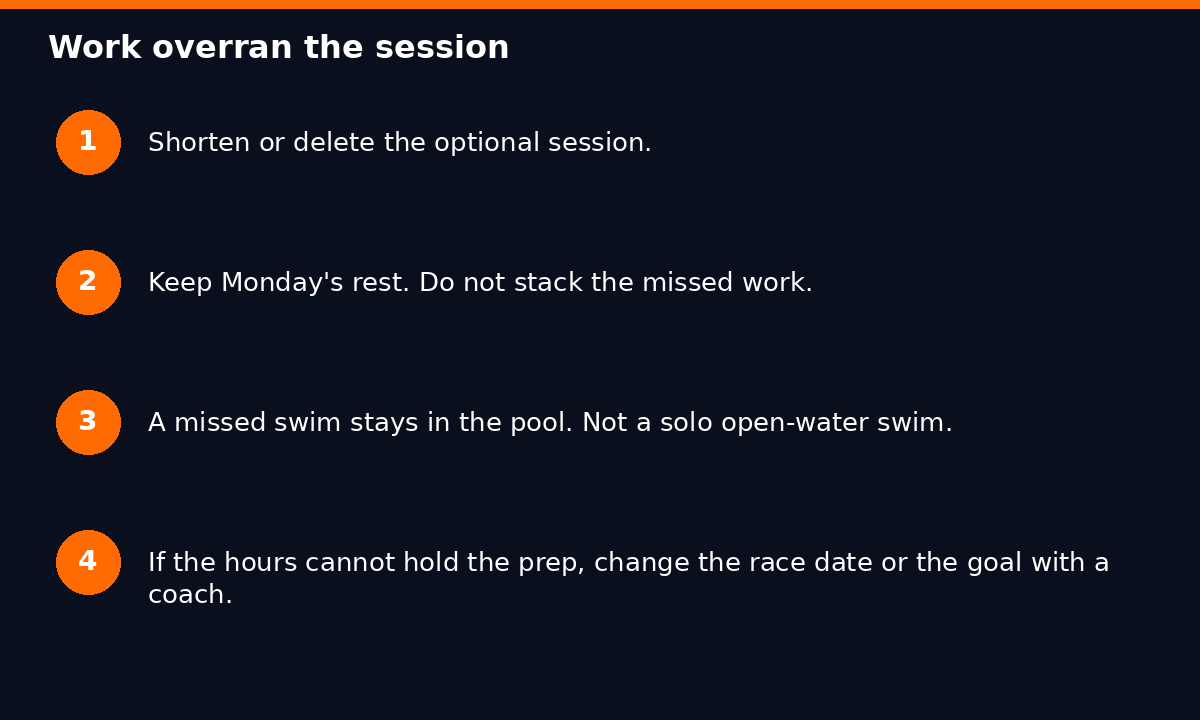
If the pool session disappears, the replacement is another pool session when a lane exists, or a shorter skill set you can do safely in the pool later. It is not a solo open-water swim squeezed in because the timetable failed. If the only way to “complete” the week is to sleep less, the week is too big.
One session is a poor summary of whether the week is workable. Weekly load matters more than yesterday’s session is a prompt to look at the whole week. It is not a set of percentages to paste onto this table.
Swimming skill and open water are separate from fitness
Pool fitness does not make you competent in open water. Keep skills and safety separate from adding minutes.
For a first open-water exposure, the RNLI’s guidance is the right shape of caution, even if you do not live in Britain or Ireland (RNLI: open water swimming):
- Swim with someone. A supervised or coached session, at a lifeguarded venue where one exists, is a better first exposure than going alone.
- Check conditions, temperature, water quality and local advice, how you will get in and out, and tides or currents. Change or cancel the plan if it is unsafe.
- A bright cap and a suitable tow float help you be seen. A tow float is not swimming ability, a supervisor, or a rescue service.
- Carry a way to call for help, and tell someone ashore what you are doing and when you will be back.
- A wetsuit depends on the conditions and on the event’s current rules. There is no blanket requirement in this article.
- Enter cold water slowly. Do not dive or jump in, and do not practise holding your breath. Cold water can disrupt breathing and swimming. Fear or distress is a reason to stop and get help, not a test of willpower.
Use the local emergency number and the venue’s own procedure. In Australia that emergency number is 000. Do not treat 999 as the number for every country. Race rules, cutoffs and wetsuit policy live in that event’s current athlete guide, not in a training article.
Do not add open water as an extra line on the table above. Pool sessions come first while you are building the base.
How to progress without turning the week into a dare
Repeat a week you can recover from before you add anything. Scale down if sleep, soreness, life stress or the sessions themselves say the load is too big. There is no mandatory percentage increase, and no recovery-score cutoff that clears you to add a session.
A single morning number is a weak reason to rewrite the week. If you use HRV, read the trend across days, next to how training actually felt. Pain that persists, or symptoms that worry you, need a qualified clinician. They are not a cue to test the injury with another easy spin.
Later preparation looks different from this base week: supervised open-water skills, longer work in each sport, bike-to-run transitions, fuelling rehearsal, and race-specific training. Those belong in an individual plan that has time for them. This scheduling piece does not prescribe what to eat or drink, beyond the obvious point that the long bike is a sensible place to practise the habit, not to attempt a maximum effort.
Short answers
Is six hours a week enough to finish a 70.3? This example is about six and a half hours for someone who already trains near that, in an early base phase. It is not a finish-time formula and not a novice minimum. What you need depends on your starting point, the course, the goal, the time you have, and whether you recover.
Can I train before work? Yes, if the session still fits sleep, the pool or a safe route, and the job you have to do afterwards. A short easy bike or a pool swim can sit there. A new hard session before a long shift is a poor trade.
What if I miss a swim? Leave it missed, or replace it later with pool time you can do safely. Do not stack it onto the long bike, and do not replace it with a solo open-water swim.
Is this a full IRONMAN plan? No. Full distance is 3.8 km of swimming, 180 km of cycling and 42.2 km of running. The week on this page is an early-base illustration for a first 70.3 around work.
P247 is intended to read training and recovery from Apple Health, with Strava as an optional extra, and to show a rules-based recovery score in a daily brief and a weekly report. It does not plan a triathlon, test whether you can swim or ride safely, or replace a coach.