If you can only own one, Garmin is the better choice for most endurance athletes. It records the session itself: GPS, pace, splits and a screen on your wrist while you are running, riding or swimming. WHOOP is the better pure recovery tracker, built to be worn 24/7 and to tell you how your body is handling load. But it has no screen, so it is not the thing you race with.
That is the short answer. The longer answer depends on what you are actually trying to decide each week.
The Question Behind the Question
Most people asking “Garmin or WHOOP?” are not really asking about hardware.
They are asking: which one will help me make better training calls?
That is a fair question. And it is where the comparison gets more interesting than a spec sheet.
What Garmin Is Built For
Garmin is a training computer you can wear to bed.
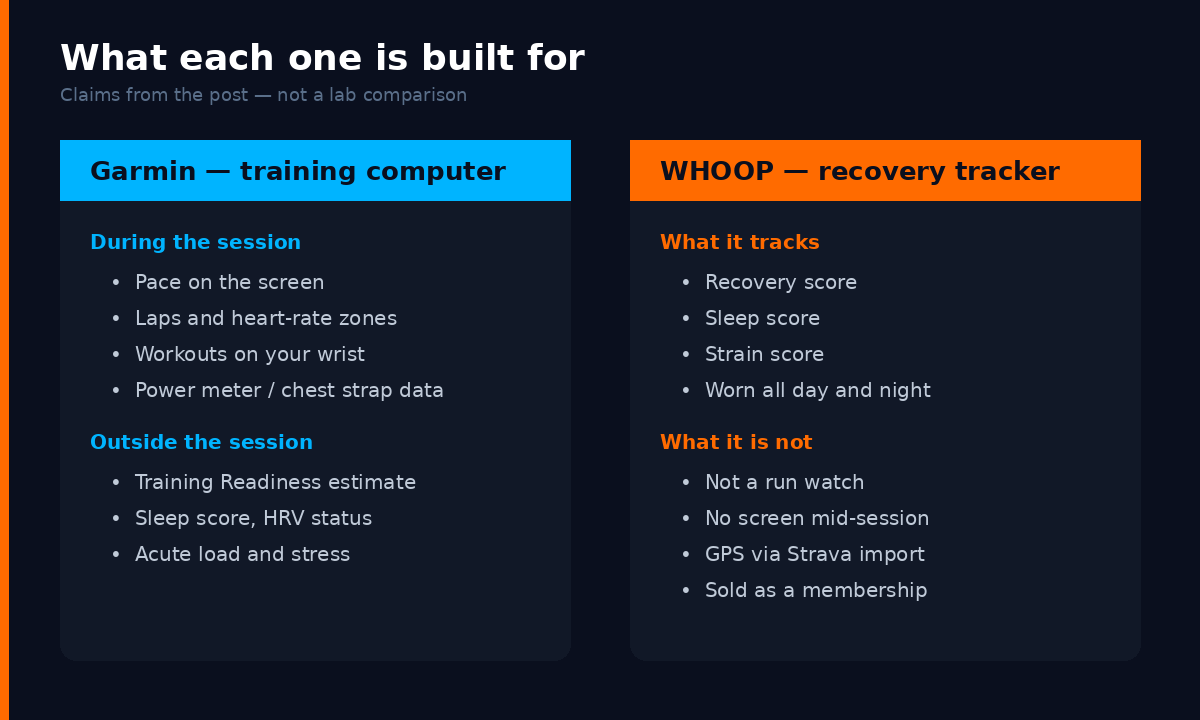
During a session it does the job you need done. Pace on the screen. Laps. Heart rate zones. Workouts pushed to your wrist. Data from a power meter or chest strap if you use one.
Outside the session, it estimates readiness too. Garmin’s Training Readiness score is built from last night’s sleep score, recovery time, HRV status, acute load, sleep over the last three nights and stress over the last three days.
So you get the workout and a recovery estimate in one device.
What WHOOP Is Built For
WHOOP is a recovery and strain tracker.
It does not try to be your run watch. It sits on your wrist or arm all day and night and turns that into three scores: Recovery, Sleep and Strain. It is sold as a membership that includes the device, rather than a one-off purchase.
For the GPS side of things, WHOOP now pulls activities in from Strava, including distance, pace, power and cadence. That tells you a lot about how WHOOP expects endurance athletes to use it. Alongside something else that records the session.
Which One Fits Your Sport
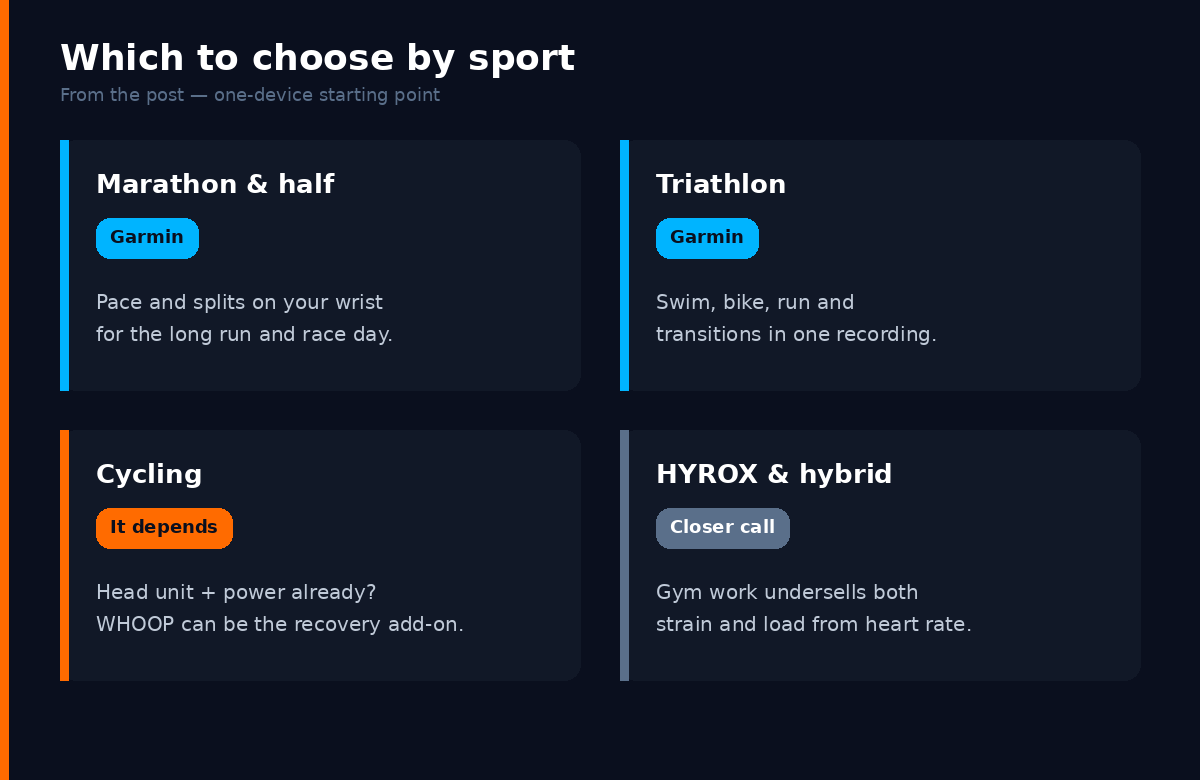
Marathon and half marathon. Garmin. You want pace and splits on your wrist during the long run and on race day. WHOOP cannot show you either mid-run.
Triathlon. Garmin. Swim, bike, run and transitions in one recording is the whole point of a multisport watch.
Cycling. It depends on your setup. If you already ride with a head unit and a power meter, the bike is covered. A WHOOP for recovery could be the better add-on than a second Garmin.
HYROX and hybrid training. Closer than you would think. A lot of a HYROX week happens in the gym, where pace and GPS matter less and the cost of strength work matters more. Both build their load numbers mostly from heart rate, and heart rate can undersell what a heavy sled push or a long wall ball set actually cost you. Whichever you choose, do not treat the strain or load number from a big strength day as the full story.
The Honest Answer for a Lot of People: Both
Plenty of athletes end up wearing a Garmin for sessions and a WHOOP for recovery.
That works. Until the two disagree.
WHOOP says green. Garmin says low readiness. Same night, same body, two different calls on whether today should be the hard session. I have written about that exact problem before, in Oura vs WHOOP vs Garmin and why they are all wrong.
Two devices give you more data. They do not give you a decision.
What Neither One Does
Here is the part the comparison reviews skip.
Neither device knows your plan. Neither knows that this is a deliberate overload week three weeks out from your marathon. Neither knows your long run was in the first hot weekend of spring, or that you flew interstate on Thursday.
So both will sometimes tell you something that is technically accurate and practically useless.
The question that matters is not “which score is right this morning?” It is “across the last week, is my training working, and what should I change?”
How I Would Choose
Ask yourself one thing. What do you need on your wrist during the session?
If the answer is pace, splits or navigation, get the Garmin. If your sessions are already covered by a bike computer or you mostly train in the gym, and what you want is a clearer picture of sleep and recovery, WHOOP makes sense.
Then stop expecting either one to coach you. They measure. Deciding is still your job.
That is the gap I built P247 for. It pulls your Garmin, WHOOP, Oura, Strava and Apple Health data together and gives you one weekly report: what is working, what is holding you back, and what to change. It does not care which device you picked. It reads them in the context of your actual week.
Your wearable measures. P247 decides.
P247 is launching on the App Store at the end of November. If you want in early, join early access here.