

A half marathon is 21.1 km. If you already run and already lift, the useful question is not whether strength training “counts”. It is which session gets your fresh legs, and what you drop when the week gets smaller.
Short answer: decide that the half marathon is the priority for this block. Protect the key run and the long run. Put familiar strength work around them, ideally several hours away from a hard run when your day allows. When life or fatigue gets in the way, cut optional lifting before you cut recovery. The days below are an illustration, not a plan you should paste on top of the week you already tolerate.
Who this week is for
This is for an established recreational runner who already lifts, and who is prioritising a half marathon while keeping useful strength. It is not a couch-to-half programme, a bodybuilding plan, or a HYROX race block.
The example later in this piece assumes someone who already tolerates about three runs and two familiar strength sessions in a normal week, in the middle of a block. It is not race week, and it is not a new lifter’s first week. Keep the duration and volume you already handle. Do not add this table on top of another programme.
Three runs is a way to draw the week. It is not a claim that three runs are enough for every half-marathon goal.
What strength is doing in this block
During a half-marathon block, strength work is there to support the running. It is maintenance and a bit of specific robustness, not an automatic attempt to chase new gym personal bests and a race peak in the same fortnight.
You can care about both. You cannot give both the same peak in the same week without a cost in fatigue, time, or the quality of the run that actually matters. The practical problem is competing priorities, not a rule that two kinds of training can never coexist.
If you are over 40, mileage on its own is a thin record of how the week landed. Why runners over 40 need strength data beside mileage is about that tracking question. This page is the timetable.
What the research supports, and where it stops
A 2022 review in Sports Medicine pooled 43 studies of healthy adults in supervised programmes lasting at least four weeks, and compared concurrent aerobic plus resistance training with matched strength-only work (Schumann et al.). In those pooled results, concurrent training did not significantly compromise maximal strength or hypertrophy. Explosive strength was a weaker spot: it could be attenuated, particularly when the two kinds of work were in the same session. In a subgroup, sessions separated by at least three hours did not show that same statistically significant drop in explosive strength.
That is not a universal three-hour safety rule, and it is not proof of the best timetable for a half-marathon runner. It does not show that running never affects muscle or strength. Workload, food, training history and the goal still matter. It also does not establish a faster half marathon, or that this combination prevents injury.
A separate 2022 review of 22 studies found that heavy resistance training added to running can improve running economy, with small pooled effects and real differences between methods and how long people trained (Eihara et al.). Running economy here means the oxygen cost of running at a given submaximal speed, which is the measure described in Running economy: the metric that actually predicts race day performance. This article does not turn that into a promised time, and it does not repeat race-gap stories as if they came from the review. Some time-trial numbers in the published abstract do not line up cleanly with their own confidence intervals, so they are left out on purpose.
Those heavy-load findings come from people who were already training. They are not a reason for a new lifter to start testing a one-rep max, jumping off boxes, or adding load every week. Use movements you already know, with technique you can hold. If the lifts are new, get qualified coaching before you load them.
Where to put the lifting
Give the day’s main job the fresh start. If Tuesday is the key run, do not arrive at it with a heavy squat still in your legs. Where the calendar allows, leave several hours between a harder run and a strength session. That is a planning option. It is not an evidence-proven rule that one order suits every runner.
Some experienced runners can put a hard run and a lift on the same day and recover. This example does not require that. If you try it, the run that matters should still be the one you do first, and the lift should be the one you are willing to shorten.
Protect two runs: the key session you already use for quality, and the long easy run. Familiar strength sits around them, not through them.
An example week
Example only. This is an established runner who already tolerates three weekly runs and two familiar strength sessions, in a normal mid-block week. It is not race week and not a novice’s first week. Keep the duration you already tolerate. Do not stack this on top of another programme. These are assumptions for the illustration, not a test you have passed.
| Day | Main work | Why, and what to change |
|---|---|---|
| Monday | Rest | Leave room after the previous long run. |
| Tuesday | The key run you already do | Quality only if it is already in your plan. Otherwise keep it as familiar easy running. |
| Wednesday | A familiar strength session | Keep the dose manageable. Cut lower-body work if Tuesday is still in your legs. |
| Thursday | Easy run | Conversational. Not a second key session in disguise. |
| Friday | A shorter familiar strength session | Leave recovery before Sunday. Reduce or skip lower-body loading if it reliably spoils the long run. |
| Saturday | Rest | No catch-up session to “make up” a missed day. |
| Sunday | The long easy run you already do | The duration comes from your existing plan and what you have recently tolerated, not from this table. |
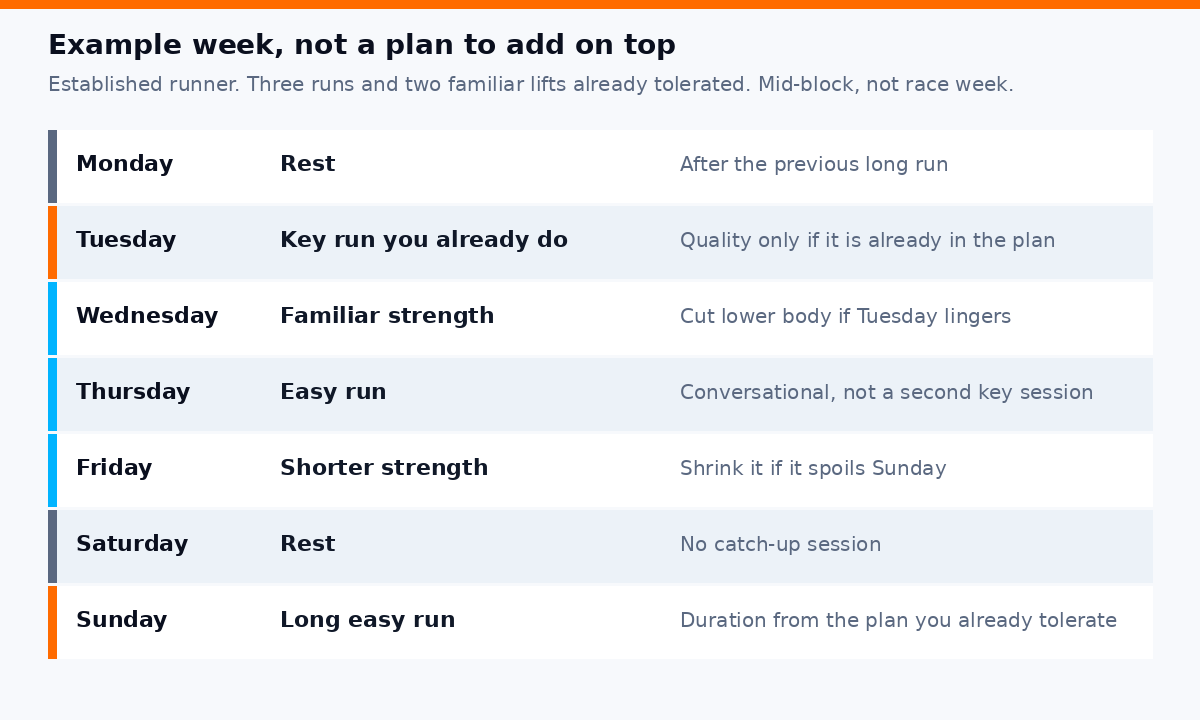
There is no promise that 48 hours is enough recovery for you. If Wednesday lifting after Tuesday does not sit well, move or reduce the lifting and look at the whole week, not just that one day. A new lifter needs a smaller introduction, not this full example on the first go. This page also does not add a universal 10 percent rule, or a fixed taper.
Keep the strength familiar
Think in patterns you already own: a squat or a hinge, something single-leg, calves, and trunk. Those are examples, not a compulsory menu. Sets, reps and load depend on what you have already been doing. Stop before failure is a reasonable default when the run is the priority. Nothing here asks you to grind a last rep.
If Friday’s lower-body work regularly makes Sunday feel heavy, Friday is the session to shrink. The long run is the one this block is protecting.
When the week gets busy
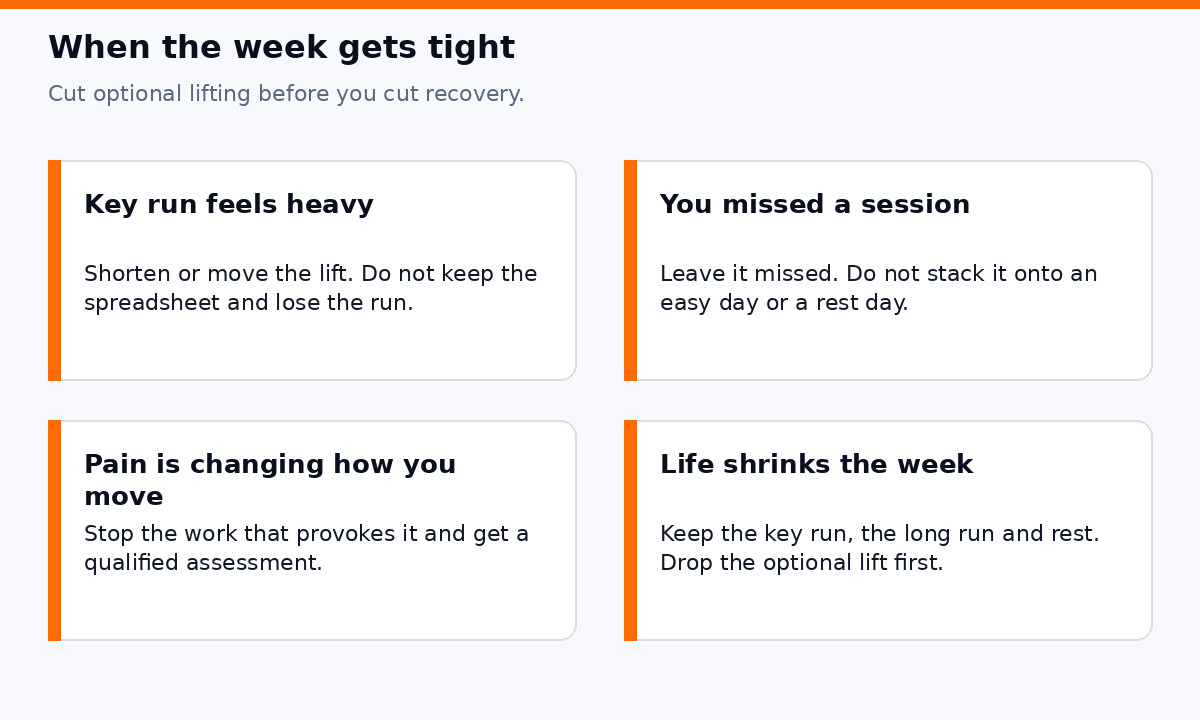
Do not cram a missed session into a day that was supposed to be easy or empty. Drop the optional work first. Shorten a lift you already know. Keep the rest day.
A single hard day is a weak summary of the week. Weekly load matters more than yesterday’s session makes that case. Use it as a reason to look at the shape of the week, not as a set of injury percentages to apply to this table.
If heavy legs are taking the edge off the key run, reduce the lifting dose or move it. Do not chase the spreadsheet.
What to check before you add more
Review how the sessions actually felt, plus soreness, sleep, pain and the rest of life. A green recovery score is not permission to train through pain. A recovery score rolls several overnight signals into one number. It does not know the session you had planned, or a calf that is changing how you run. One morning’s HRV is also a weak reason to rewrite the week. The more useful read is the trend over days, next to how you actually feel.
If fatigue is sticking around, pain is worsening, or your movement has changed, reduce or stop the work that provokes it and get a qualified assessment. Symptoms that feel urgent need urgent care, not another easy jog to test them.
Short answers
Can I lift on a run day? Yes, if you already recover from that combination, and if the run that matters is done first or several hours clear of the lift. If the lift leaves the key run flat, the lift changes, not the priority.
Do I need two strength sessions? The example uses two because that is what this imaginary runner already tolerates. It is not a minimum, and it is not a target that improves your half marathon by itself. One shorter, familiar session can be enough while running is the priority.
Should I lift before the long run? Not if the long run is the point of the week. The example keeps a rest day between the shorter Friday lift and Sunday, and it tells you to cut Friday’s lower-body work if Sunday suffers. Lifting immediately before a long run is a poor trade for most people in this block.
P247 is intended to read training and recovery from Apple Health, with Strava as an optional extra, and to show a rules-based recovery score in a daily brief and a weekly report. It does not build this week, decide that you are cleared to train, or replace a coach.