
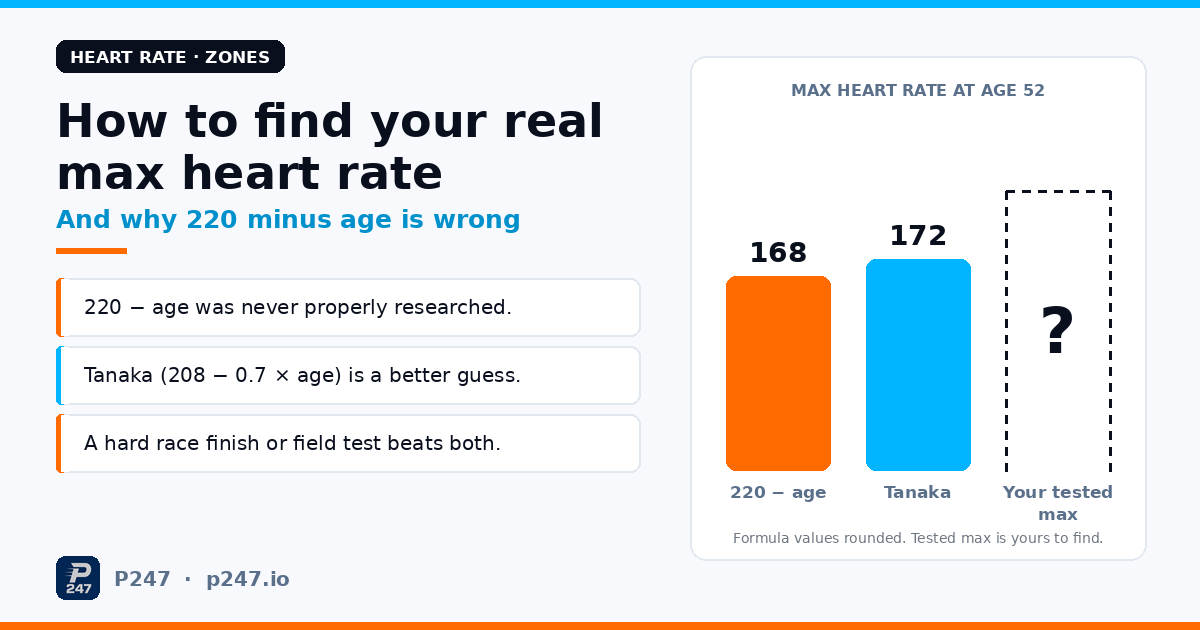
The quickest way to find your real max heart rate is to look at the highest heart rate you’ve actually reached at the end of a hard race or an all-out effort, recorded with a chest strap if you can, and to ignore any single reading that sits far above everything else in your data. A formula like 220 minus age, or the better Tanaka formula (208 − 0.7 × age), is only a starting guess until you have that number.
That matters more than most people think, because heart rate zones are usually built from your max. If the max is wrong, every zone is wrong.
I’m 52. The two formulas put my max at 168 and about 172. Neither of them has ever seen me finish a HYROX or the last kilometre of a half-marathon. Here’s how I’d go about finding a number you can actually trust, and where I think athletes go wrong.
Why 220 minus age is the wrong place to start
220 minus age is everywhere: gym posters, treadmill screens, certification courses. It’s also much weaker than its popularity suggests.
In 2002, exercise physiologists Robert Robergs and Roberto Landwehr went looking for where it came from. In their review, they found it wasn’t developed from original research at all. It came from an eyeballed line of best fit through data from about 11 sources compiled in 1971. They reported that research using the formula showed a large prediction error, a standard error of 7 to 11 beats per minute, and concluded it had “no scientific merit” for use in exercise physiology.
A standard error that size means plenty of people sit 10 or more beats away from what the formula says. For one athlete it’s close enough. For the next, their “easy” zone 2 runs are really zone 3.
The Tanaka formula is better, but it’s still a guess
In 2001, Hirofumi Tanaka, Kevin Monahan and Douglas Seals revisited age-predicted max heart rate. They pooled data from 351 studies covering 18,712 people, then checked the result in a lab study of 514 healthy adults aged 18 to 81. Their equation was 208 − 0.7 × age, and they found it didn’t differ between men and women or with how active people were. They also concluded that 220 minus age underestimates max heart rate in older adults.
You can see that in the numbers. The two formulas give the same answer at 40. After that, Tanaka gives a higher max than 220 minus age, and the gap grows with every birthday:
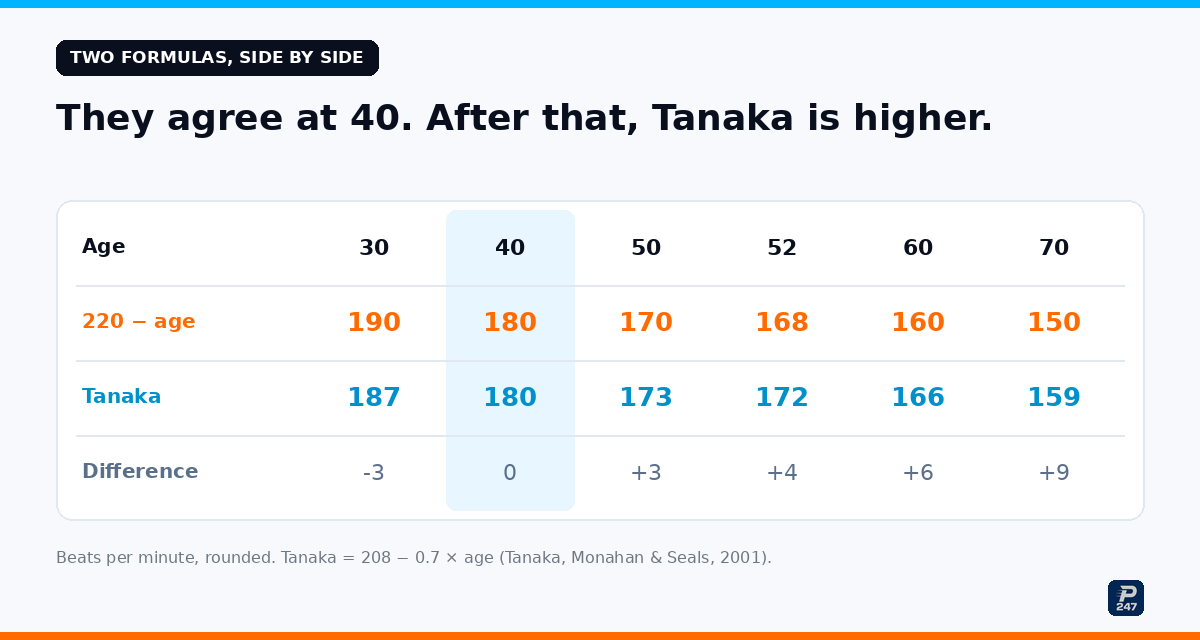
For masters athletes, that’s not a small detail. If you’re over 40 and you’ve set your zones from 220 minus age, the formula is likely to put your zones lower than Tanaka would.
But here’s the honest part: Tanaka is still an average across a lot of people. It describes the population well. It can still be well off for you. A formula is what you use until you’ve got a real number, not instead of one.
How to find your real max heart rate
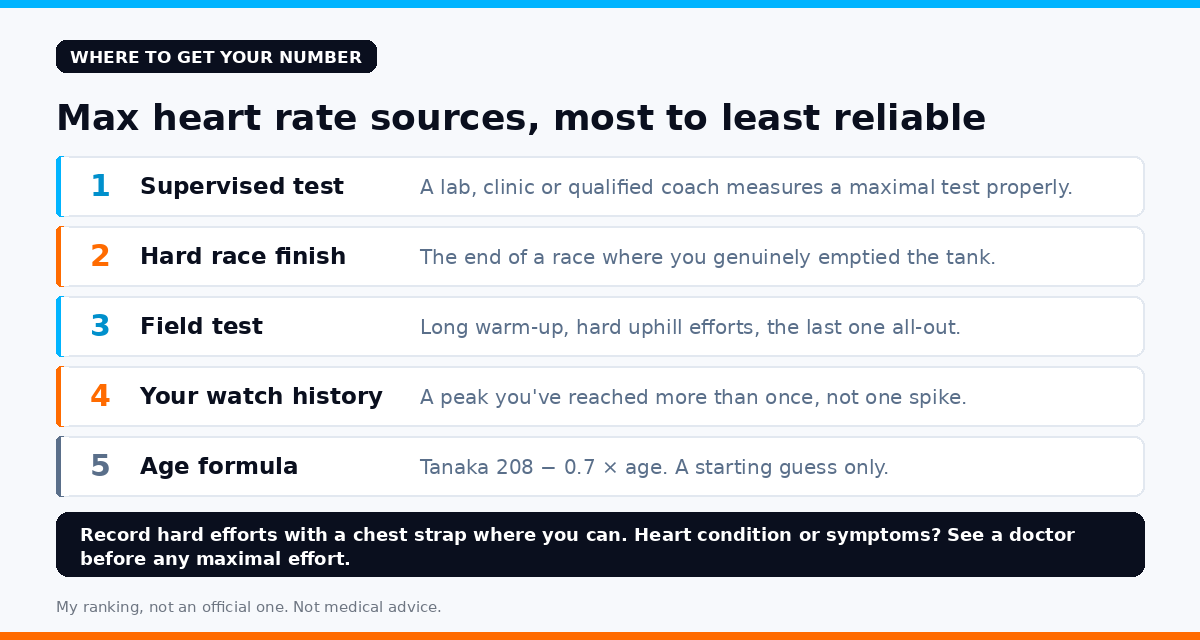
There are three ways to get a better number than a formula. In order of what I’d trust most:
1. A supervised test. A lab, sports clinic or qualified coach can run a structured, maximal test while measuring your heart rate properly. It’s the most reliable option, and the right one if you have any heart condition, symptoms or doubts about your health.
2. A hard race finish. The end of a race where you genuinely emptied the tank is one of the best real-world sources you have. For me, that’s the last few hundred metres of a half-marathon or the final run and wall balls in HYROX. In my experience, a hard finish after a properly fast effort gets closer to max than anything in the middle of a long steady session, where you’re rarely truly maximal.
3. A field test. If you don’t have a recent race, a common approach is a long, thorough warm-up, then a few hard efforts of a few minutes each, ideally uphill, with the last one finishing all-out. Your max is the highest reliable heart rate you see near the end. This is a coaching field test, not a lab protocol, and it’s genuinely hard. Do it fresh, not in a heavy training week, and only if you’re healthy.
Whichever you use, record it with a chest strap if you can. Apple says wrist readings can be affected by cold weather, which reduces blood flow in the skin, by some tattoos, and by irregular movement. It suggests a Bluetooth chest strap if you can’t get consistent readings (Apple Support). A Bluetooth chest strap connects to Apple Watch, so you can still record the workout from your wrist.
And treat one test as one data point. If a race and a field test agree within a few beats, you’ve probably found it. If they don’t, the higher reliable value is usually closer to the truth, because it’s hard to exceed your max but very easy to fall short of it.
Can you trust your Apple Watch’s highest recorded heart rate?
Sometimes. Your watch history is worth checking, because if you race or do hard intervals, you may already have reached something close to your max. But I’d be careful with the single highest number on the screen.
Apple is upfront that “some anomalies may appear in the displayed data, resulting in occasional heart rate measurements that are abnormally high or low” (Apple Support). Its heart rate paper also says rhythmic movement like running and cycling is easier to track than irregular movement, and that activities with a lot of wrist and finger movement are harder. That’s a good description of a HYROX session: sled pulls, burpees, wall balls and farmers carries.
So my rules for reading your own history are:
- Look for a value you’ve reached more than once, in different sessions, not one isolated peak.
- Check the graph around it. A real max builds up over the final minutes of a hard effort. A spike that jumps 20 beats in a few seconds and drops straight back is more likely an error.
- Distrust peaks from strength or HYROX station work unless you were wearing a chest strap.
- Prefer running or cycling sessions where the effort ramped up to a genuine finish.
Running and cycling may not give the same number
Don’t assume the max you see running applies on the bike or the rower. Your heart rate can top out at a different number in different sports, so if you train zones by heart rate in more than one sport, check each one rather than copying one number across. Triathletes in particular should check this before setting bike zones from a run test.
Setting your heart rate zones from it
Once you have a number you trust, use it. On Apple Watch, Heart Rate Zones are a percentage of your max heart rate and are calculated automatically from your health data. They’re only calculated if you’ve entered your date of birth in the Health app. Apple’s support page describes editing the zones manually rather than typing in a max: on your iPhone, open the Watch app, go to My Watch, then Workout, then Heart Rate Zones, tap Manual, and set the limits for zones 2, 3 and 4 (Apple Support).
Here’s why getting the max right matters. If your zone 2 is set at 60 to 70 percent of max, purely as an illustration:
- with a max of 168, zone 2 tops out at about 118 bpm
- with a max of 185, zone 2 tops out at about 130 bpm
Same athlete, same run, a 12-beat difference in what counts as easy. Get the max wrong in one direction and your easy runs drift into moderate territory. Get it wrong the other way and your threshold intervals end up too soft. I went into the wider zone-setting problem, including threshold testing, in why your training zones are wrong, and there’s a short explainer on heart rate zones and max heart rate in the glossary.
One more thing: max heart rate is not a fitness score. A higher max doesn’t make you fitter. In the Tanaka study it was predicted largely by age, regardless of how active people were, and it falls slowly as you get older. That’s normal. What changes with training is how much work you can do below it.
Where P247 fits
P247 uses your maximum heart rate to work out your training load and fitness from the workouts your watch saves to Apple Health, and from Strava if you connect it. It uses a max you’ve set yourself first, then an age-based Tanaka estimate if you’ve added your date of birth, then a default of 170 bpm. When you save a new max, it rescores your past workouts, training load and fitness in the background.
If you’re unsure where to start, the Heart screen can scan a year of your Apple Health running workouts and suggest a max for the in-app zones, based on the highest heart rate you held for a complete minute rather than a short spike. Nothing changes until you accept it. The steps are in how to set your maximum heart rate in P247.
This is general information, not medical advice. Maximal efforts are hard on the body. If you have a heart condition, any symptoms or you’re unsure, talk to your doctor before testing your max heart rate.
If you want your training load built on your real max heart rate, sitting next to your sleep and recovery in one place, P247 is on the App Store.
P247 is available now on the App Store. Connect Apple Health and get your first weekly performance report free.