
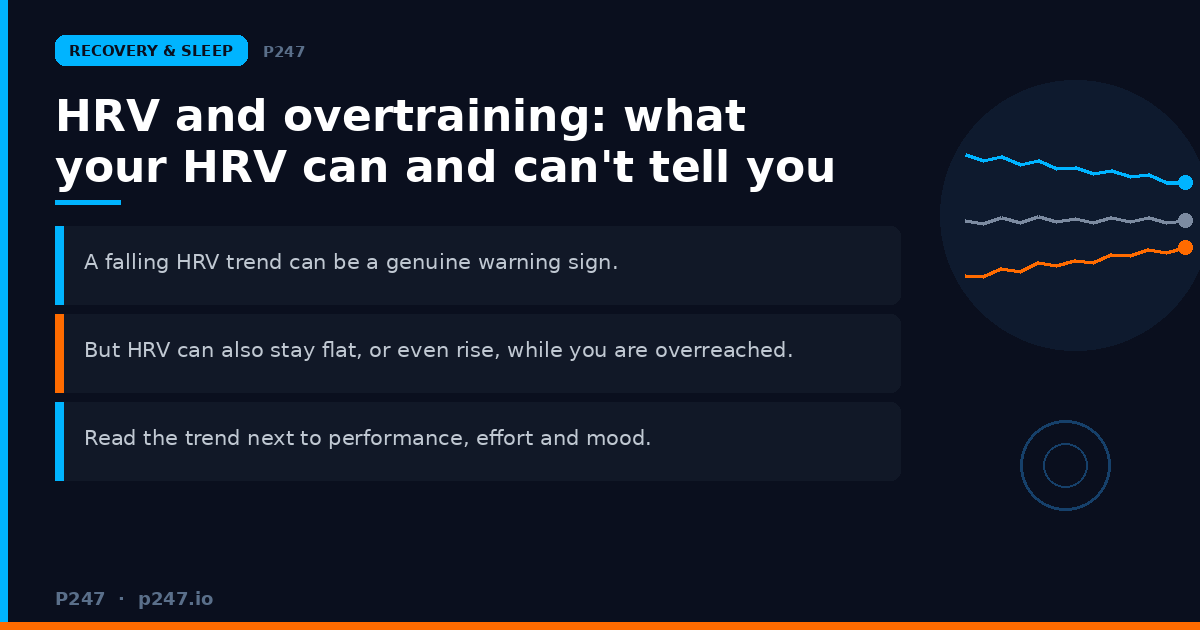
Can HRV tell you that you are overtraining? Sometimes. Usually later than you would like. And only if you read it as a trend, next to other signals, rather than as a single number each morning.
A falling HRV trend during a hard block can be a genuine warning sign. But HRV can also stay flat, or even go up, while you are digging yourself into a hole. On its own, last night’s reading cannot tell you whether you are adapting or breaking down.
That is the short answer. Here is why, and what I would look at instead.
First, what “overtraining” actually means
Most athletes use “overtrained” to mean “I feel smashed.” The research uses three different terms, and the difference matters.
The joint consensus statement from the European College of Sport Science and the American College of Sports Medicine separates them like this:
- Functional overreaching. A short-term drop in performance from hard training that comes back better after recovery. This is the point of a good overload block.
- Non-functional overreaching. You pushed past what you could absorb. Performance drops and takes weeks or longer to come back, with no payoff.
- Overtraining syndrome. A prolonged maladaptation. Performance and mood stay down for weeks or months despite rest.
Two things from that statement are worth knowing before you trust any app that claims to spot overtraining. First, there is no single test that diagnoses it. Second, the line between non-functional overreaching and overtraining syndrome is hard to draw even for clinicians, and diagnosis means ruling out other causes like illness, iron deficiency or under-eating.
If the experts cannot diagnose it from one marker, your watch cannot either.
What the research says about HRV and overreaching
This is where it gets uncomfortable for anyone who treats HRV as a traffic light.
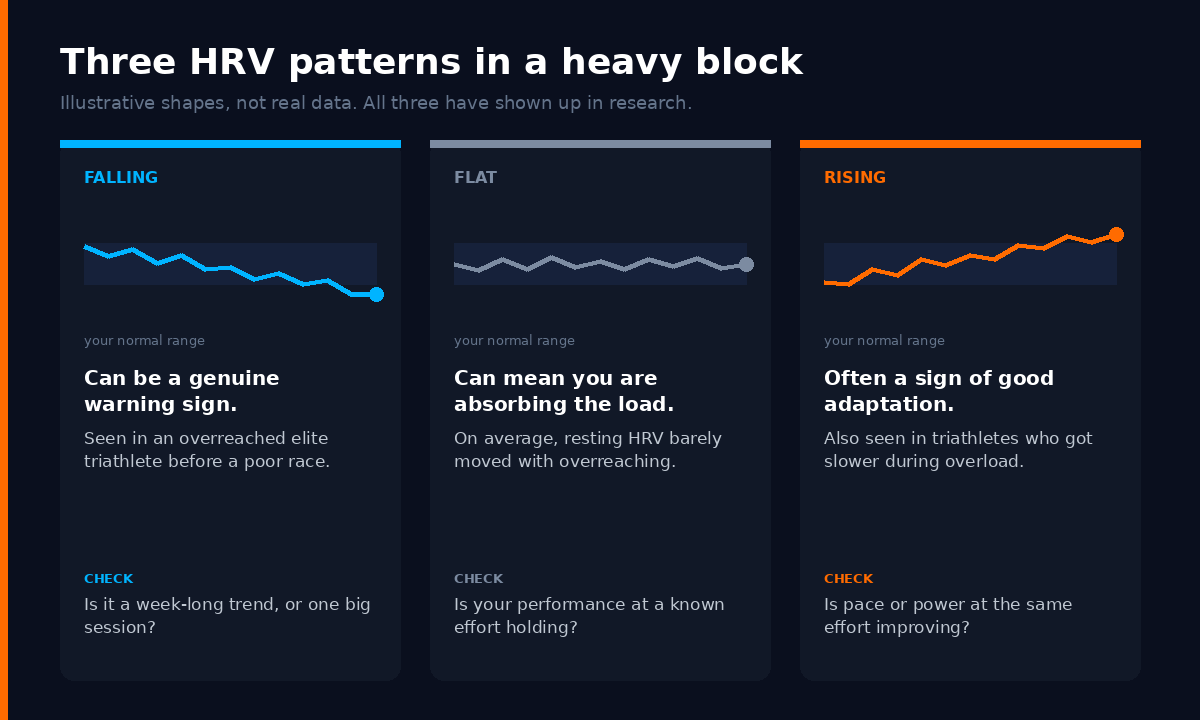
HRV can go up when you are overreached. In a study of trained triathletes by Le Meur and colleagues, one group did three weeks of overload training. Every athlete in that group got slower by the end of the overload, then improved after a taper. Their weekly-averaged HRV did not fall during the overload. It rose, with markers of parasympathetic activity increasing, and reversed during the taper. The same paper found that a single HRV reading once a week did not reliably pick up the change at all, because day-to-day variation was too large.
HRV can also go down. In a case comparison of two elite triathletes by Plews and colleagues, the athlete who became non-functionally overreached showed a declining 7-day rolling average of HRV in the lead-up to a poor race, and less day-to-day variation in HRV. The other athlete’s HRV stayed stable. It is two people, so treat it as a useful illustration rather than a rule.
And on average, resting HRV barely moves. A systematic review and meta-analysis by Bellenger and colleagues pooled studies of endurance athletes. Training that improved performance was associated with increases in vagal-related HRV. But resting HRV was largely unaffected by overreaching, and some HRV and heart rate recovery measures increased with both good and bad adaptation. The authors’ conclusion was that additional measures are needed to tell the two apart.
Put those together and you get the honest picture. During a heavy block, HRV might fall, stay flat or rise. A rise can mean you are adapting well, or it can show up when performance is going backwards. Direction alone does not give you the answer.
Why your wearable makes this harder
Wearables did not create this problem, but the way they present HRV can hide it.
The daily score is about yesterday. A low reading the morning after a big session is a normal acute response. That is not overtraining. If you react to every red morning, you will back off from the exact sessions that make you fitter.
The baseline moves with you. Most devices compare last night to your own recent normal. That is sensible. But if your normal slowly drifts over a long block, a slow change can look like “within range” every single day.
Different devices measure different things. Apple Watch has long reported HRV in the Health app as SDNN, measured opportunistically when you are still. The newer Series 12 and Ultra 4 add a separate Recovery HRV reading. Other devices use their own methods and measurement windows. None of that is wrong, but it means the number from one device is not interchangeable with another, and a new metric needs its own baseline rather than being spliced onto years of old data.
Heart rate is not the whole load. For HYROX and hybrid athletes, a lot of the week happens in the gym. A heavy sled session or a long wall ball set can leave your legs wrecked for days while the heart rate side of the picture looks modest. HRV is a heart signal. It does not see sore quads.
What to track alongside HRV
The consensus statement’s own advice on prevention is unglamorous: keep a training log, and monitor performance, perceived effort and how you are feeling psychologically. HRV fits inside that, not above it.
Here is what I would put next to it each week:
- Your 7-day HRV trend against your normal range. Not this morning’s number. Is the weekly average drifting, and in which direction?
- Resting heart rate trend. Same idea. A week-long shift tells you more than one high morning.
- Performance at a known effort. The same easy loop, the same turbo session, the same HYROX simulation. Is your pace or power for the same heart rate or effort holding, improving or slipping?
- Effort for the same session. If the session you always do now feels a lot harder, write that down. Rising perceived effort for the same output is one of the most useful early signals you have.
- Mood, motivation, sleep and soreness. Boring to log. Hard to fake.
- Context. Was this a planned overload week? Did you travel, get sick, sleep badly for work, or train in the first heat of the season?
Then read them together. HRV is one witness, not the judge.
How I would actually read it
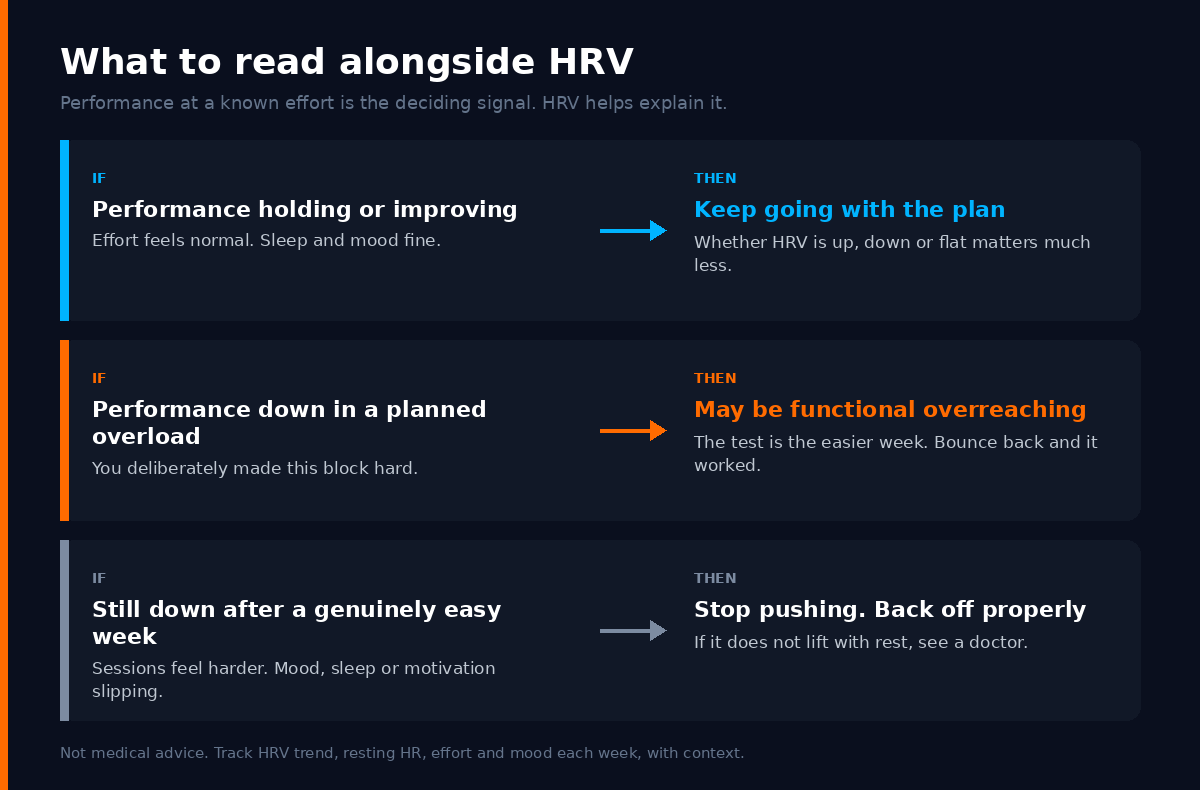
If your performance at a known effort is holding or improving, your effort feels normal and you are sleeping and feeling fine, keep going with the plan. It does not matter much whether HRV is up, down or flat.
If performance has dropped during a block you deliberately made hard, that may be exactly what functional overreaching looks like. The test is what happens after the easier week. If you bounce back, the overload did its job.
If performance stays down after a genuinely easy week, sessions feel harder than they should, and your mood, sleep or motivation have slipped too, that is when I would stop pushing. Back off properly, not just for a day. And if it does not lift with rest, see a doctor. The consensus statement is clear that other causes, including illness and nutrition, need to be ruled out, and that is not something a wearable can do.
This is not medical advice. It is the way I think about the numbers.
The point
HRV is a good signal. I would not train without it. But “is my HRV down?” is the wrong question. The useful question is “across the last week or two, is my training working, and does the HRV trend agree with what my performance, effort and mood are telling me?”
If you want more on reading HRV properly, I have written about why the trend matters more than today’s number and why HRV can look fine the week before you overtrain.
That weekly question is what I built P247 to answer. It reads your HRV next to your training and how your sessions are actually going, and gives you one weekly report: what is working, what is holding you back, and what to change. Apple Health on its own is enough to get started, and you can connect Strava for more training detail. Your first report is free.
P247 is launching on the App Store at the end of November. If you want in early, join early access here.