A female athlete opens her watch and sees the usual advice. Recovery looks good. Training readiness is green. Suggested session is intervals.
She knows her period is due tomorrow.
The device knows it too. She logged it. It has months of cycle history. It tracks skin temperature, sleep, resting heart rate and HRV.
Still, the training advice looks like it was written for a body with no cycle at all.
That is the problem.
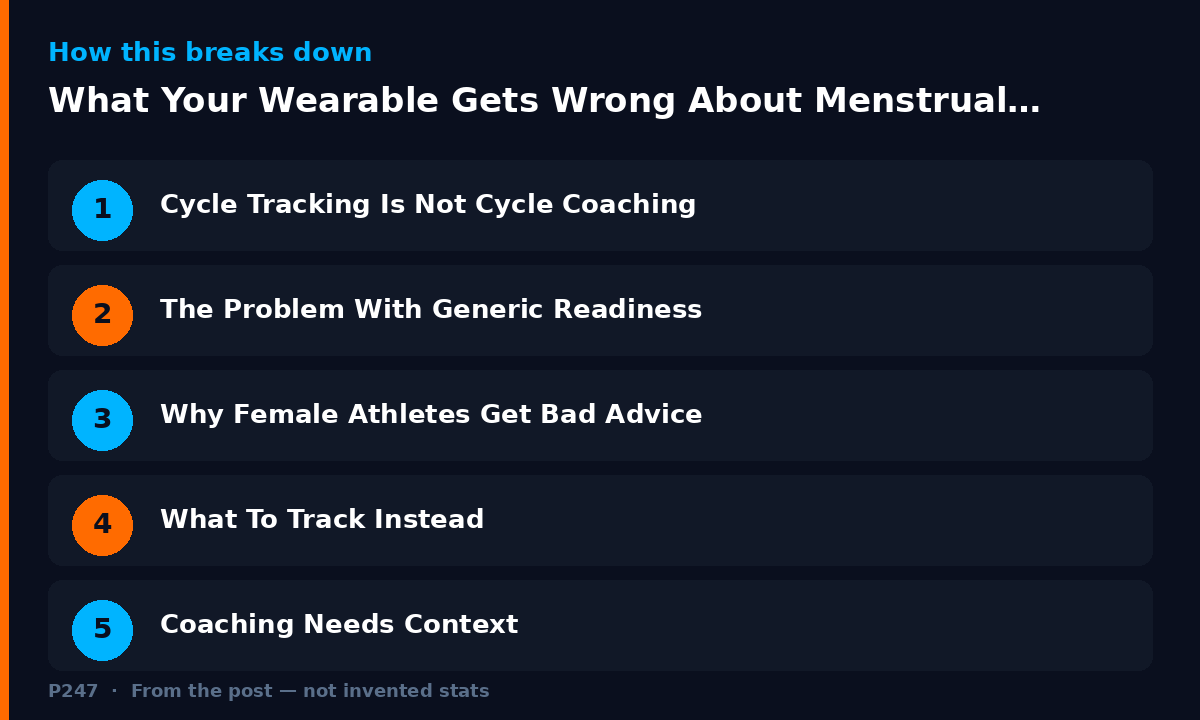
Cycle Tracking Is Not Cycle Coaching
Most wearable cycle features are calendar tools with better graphics.
They can predict period start dates. Some estimate fertile windows. Some show temperature shifts. That is useful, but it is not the same as adjusting training guidance.
Training is affected by more than the date on the calendar.
Sleep can change. Core temperature can change. Fluid balance can change. Perceived exertion can change. Strength output, mood, appetite and coordination can all shift across the cycle.
The device may record pieces of this. It rarely uses them well.
The Problem With Generic Readiness
A readiness score built mainly from HRV, resting heart rate and sleep can miss cycle context.
A green score during the late luteal phase does not always mean “go hard.” A lower score during menstruation does not always mean “do nothing.” The individual pattern matters.
Some athletes perform well during their period. Some need to reduce intensity. Some tolerate strength better than high intensity conditioning. Some are fine until sleep falls apart.
The useful question is not “what phase are you in?”
The useful question is “how does your body usually respond in this phase, and what is different today?”
Most devices do not answer that.
Why Female Athletes Get Bad Advice
The training world still defaults male.
A lot of load models were built around data that under-represents female physiology. Even when female athletes are included, the cycle is often treated as noise rather than context.
That leaves athletes doing the interpretation themselves.
They learn that a session feels harder at a certain point in the month. They learn that sleep changes before bleeding starts. They learn that heavy lower body work feels different on certain days. The wearable keeps giving the same generic advice.
That is wasted data.
What To Track Instead
If you are a female athlete, the most useful move is to build your own pattern map.
Track cycle day, symptoms, sleep quality, resting heart rate, HRV, training output and perceived exertion. Do it for three cycles. Not one. Three.
Look for repeat patterns.
Does resting heart rate rise before your period? Does HRV dip? Do intervals feel harder? Does strength hold but conditioning suffer? Does appetite change enough to affect recovery?
That is the information that should shape training.
Coaching Needs Context
This is where a coach still matters. A good coach does not blindly reduce training because of cycle phase. They watch the athlete.
Some days you push. Some days you adjust. Some weeks the best move is to keep intensity but lower volume. Other weeks the right move is to shift the hard session by 48 hours.
The decision should come from the athlete’s history, not a generic phase chart.
The P247 View
P247 is not trying to turn cycle data into a gimmick. The goal is simpler.
Your body produces patterns. Training should respect them.
A wearable that knows your cycle but does not meaningfully adjust context is leaving value on the table. Female athletes deserve more than period predictions and pink dashboards.
They deserve performance intelligence that learns their actual response.
If your wearable gives you a score but ignores the context behind it, the score is incomplete. P247 is being built for athletes who need the whole picture.
X Thread
1/ Cycle tracking is not cycle coaching.
2/ Most wearables can predict period dates. Few meaningfully adjust training advice from cycle history.
3/ A green readiness score before your period does not always mean go hard. A lower score during menstruation does not always mean rest.
4/ Track cycle day, symptoms, sleep, HRV, resting HR, output and RPE for three cycles. Patterns matter.
5/ Female athletes need performance intelligence built around their actual response, not generic phase charts.
Green score. Destroyed legs. There are blind spots in your wearable data. P247 is being built to connect the numbers with what actually happened.
Download the Free Guide