
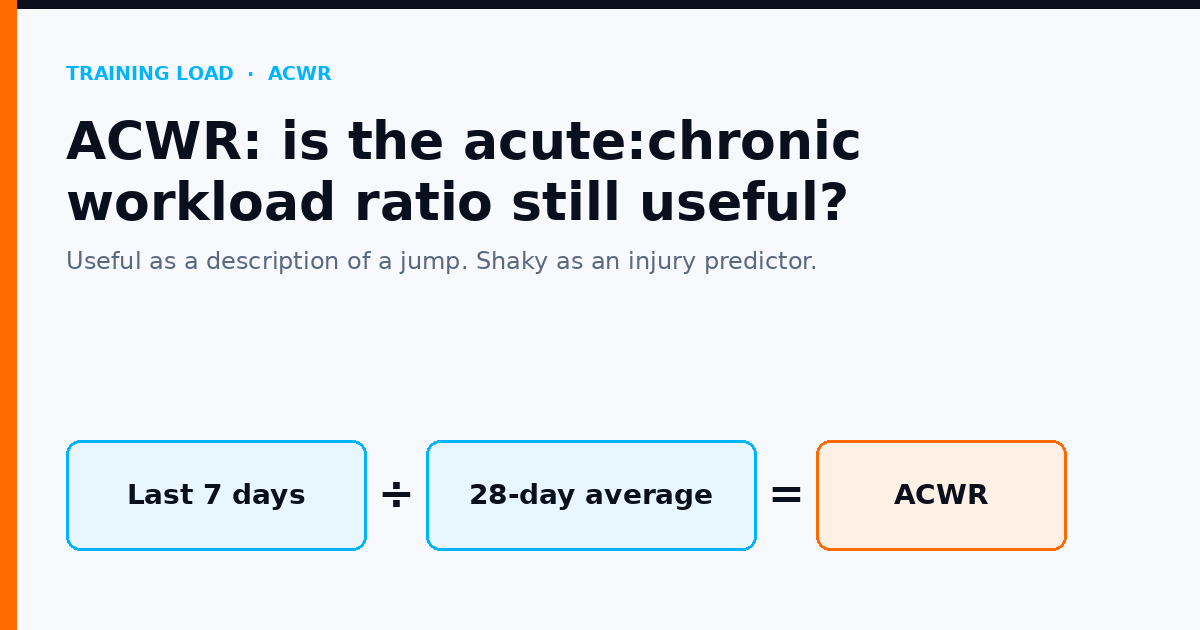
The acute:chronic workload ratio (ACWR) divides your training load for the last week by your average weekly load over roughly the last four. A ratio around 1.0 means this week looks like your recent normal. Well above 1.0 means a jump.
Is it still useful? As a rough way of describing “this week is a lot more than usual”, yes. As an injury predictor with a safe zone and a danger zone, I don’t think it holds up, and several researchers who’ve examined it closely argue the same.
I’ll be upfront: back in April I wrote that ACWR predicts injury risk better than almost any other single metric. I’ve since read the criticism properly, and I’ve changed my mind. This post is the correction, written for runners and HYROX athletes rather than the team sports where ACWR was born.
Short answers
What is a good ACWR? The most quoted range is 0.8 to 1.3, with 1.5 and above called the “danger zone”. Those numbers come from team sports research, and later work has questioned whether the ratio predicts injury at all. Treat them as a talking point, not a safe zone.
Is ACWR still used? Yes. It’s still common in coaching and load-monitoring tools, and the Aarhus University team behind a large runner study says it’s built into sports watch software. But a 2021 analysis in Sports Medicine recommended it be dismissed as a framework, and a large 2025 study of runners didn’t find the pattern the ratio is supposed to warn about.
What should I watch instead? Big jumps in a single session (especially your longest run), the actual size of any weekly increase, how you’re responding (sleep, resting heart rate, HRV trend, how easy runs feel), and new kinds of load your watch can’t see well. More on each below.
How ACWR is calculated
The classic version is simple:
- Acute load is your load for the last 7 days.
- Chronic load is your average weekly load over the last 28 days.
- ACWR is acute divided by chronic.
“Load” can be anything you track consistently: kilometres, minutes, minutes multiplied by a 1 to 10 effort rating, or a heart-rate based score. The ratio doesn’t care which, which is part of the problem.
There are two common variations. In the original “coupled” version, the current week is counted in both the top and the bottom of the ratio. In an “uncoupled” version, the chronic average uses only the three weeks before. And instead of plain rolling averages, some people use exponentially weighted moving averages (EWMA), which give recent days more weight. Sean Williams and colleagues proposed EWMA in a 2017 letter in the British Journal of Sports Medicine, showing that athletes with identical rolling-average ratios could get different EWMA ratios depending on when their load was done.
That’s the first thing worth knowing: there isn’t one ACWR. The same training can give you different numbers depending on which version your app uses.
Where the 0.8 to 1.3 “sweet spot” came from
The idea took off with Tim Gabbett’s 2016 review, The training-injury prevention paradox. Drawing on research in sports like cricket, Australian football and rugby league, it argued that excessive and rapid increases in training load are likely responsible for a large proportion of non-contact soft-tissue injuries, and that high chronic load, built up appropriately, may be protective. It described ratios of 0.8 to 1.3 as the training “sweet spot” and 1.5 and above as the “danger zone”.
The underlying message, don’t make big sudden jumps and build your fitness gradually, is sensible, and I still agree with it. The trouble is with the number that was meant to measure it.
The known pitfalls
1. Mathematical coupling. In the coupled version, this week is part of both the numerator and the denominator. Lorenzo Lolli and colleagues showed in BJSM that this creates a spurious correlation between acute and chronic load, and recommended the uncoupled version instead. Even ACWR’s supporters accepted the point: Johann Windt and Tim Gabbett replied agreeing that the coupling is real, while arguing the ratio could still play a part in a critical approach to load management.
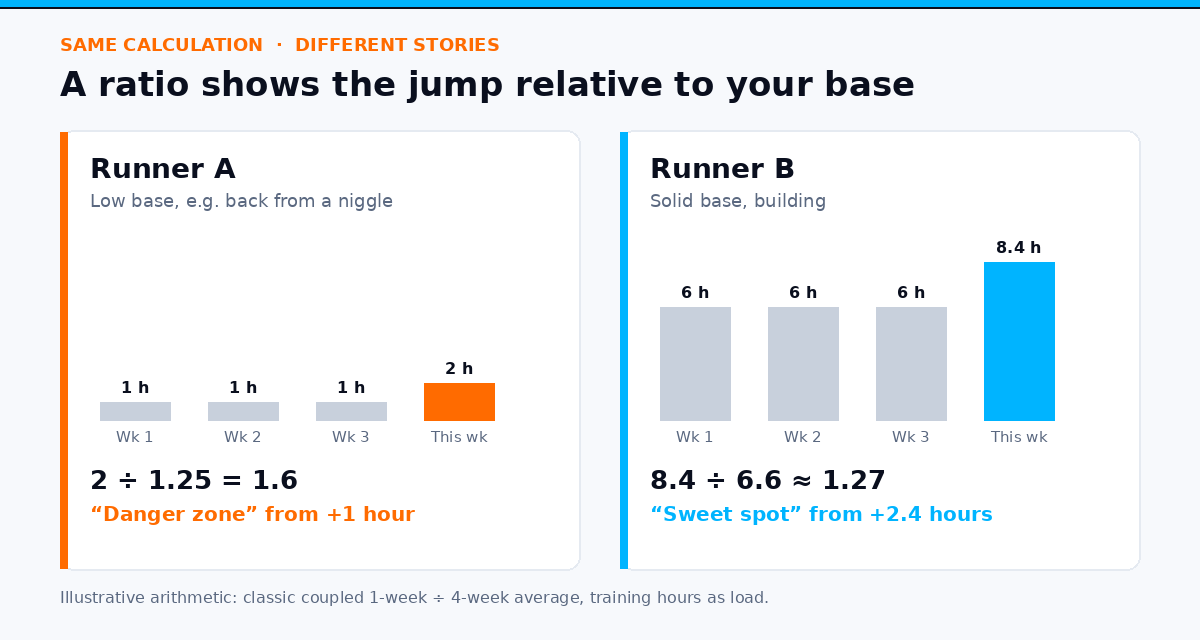
2. A ratio hides the size of the change. A ratio tells you how big the jump is compared with your base, not how big it is. Here’s simple arithmetic, using the coupled 4-week version and training hours as the load:
- Runner A has had three weeks of 1 hour (say, coming back from a calf niggle) and does 2 hours this week. ACWR = 2 ÷ 1.25 = 1.6. “Danger zone.”
- Runner B has had three weeks of 6 hours and does 8.4 hours this week. ACWR = 8.4 ÷ 6.6 = about 1.27. “Sweet spot.”
Runner A added one hour. Runner B added 2.4 hours. Which week is riskier depends on far more than the ratio, but it’s clearly not as simple as A red, B green.
This is the low-base problem every runner coming back from illness, injury or a holiday knows. After a quiet fortnight, almost any normal week looks like a spike. After a month of steadily overdoing it, the overload becomes the new “chronic” and the ratio settles back down. I made the same point about Apple Watch’s 7-day versus 28-day comparison in Apple Watch training load explained.
3. No evidence that changing the ratio changes injuries. In 2020, Franco Impellizzeri and colleagues published Acute:Chronic Workload Ratio: Conceptual Issues and Fundamental Pitfalls in the International Journal of Sports Physiology and Performance. Their argument is that telling athletes to keep the ratio in a range assumes that changing it causes a change in injury risk, and that no studies had even tried to estimate that causal effect properly. They also argued the ratio is an ambiguous, inaccurate metric that adds noise and creates statistical artefacts. Their conclusion was that there’s no evidence supporting ACWR in training-load management systems or training recommendations aimed at reducing injury risk.
4. The chronic part may not be doing anything. A year later, Impellizzeri and colleagues went further in Sports Medicine. Using previously published data, they replaced the real chronic load with fixed and even randomly generated numbers and got similar injury associations to the real ratio. They concluded ACWR is effectively a rescaling of acute load, that neither ACWR nor acute load alone gave a meaningful predictive advantage, and suggested ACWR be dismissed as a framework.
5. Runners weren’t the original population. The sweet-spot numbers came from team sports. For runners, the biggest study I’ve found is the Garmin-RunSafe Running Health Study led by Rasmus Nielsen at Aarhus University, published in BJSM in 2025. It followed 5,205 runners for 18 months using their Garmin data. When a single run was more than 10% longer than their longest run in the previous 30 days, the rate of overuse injury was higher. But for an ACWR comparing one week with the previous three, they found a negative dose-response relationship, the opposite of what the ratio is supposed to warn about, and no relationship for a week-to-week ratio. It’s an observational study with self-reported injuries, so it doesn’t prove cause either. But it’s a lot closer to how most of us actually train than a rugby squad.
So is ACWR still useful?
My honest view, as a 50-something athlete who trains for HYROX and half marathons rather than a sports scientist:
- Useful: as a plain-English description. “This week is about one and a half times what I’ve been doing” is a perfectly good thing to notice, especially when you plan a build.
- Not useful: as an injury forecast, a traffic light, or a reason to add a session because you’re “only at 0.9”. The thresholds don’t carry the weight people put on them.
- Actively misleading: coming back from time off, when the ratio flags a sensible return as dangerous, and after weeks of creeping overload, when it tells you everything is normal.
The principle survives the number. Don’t make big, sudden jumps. Build gradually. You don’t need a ratio with two decimal places to apply that.
What I watch instead
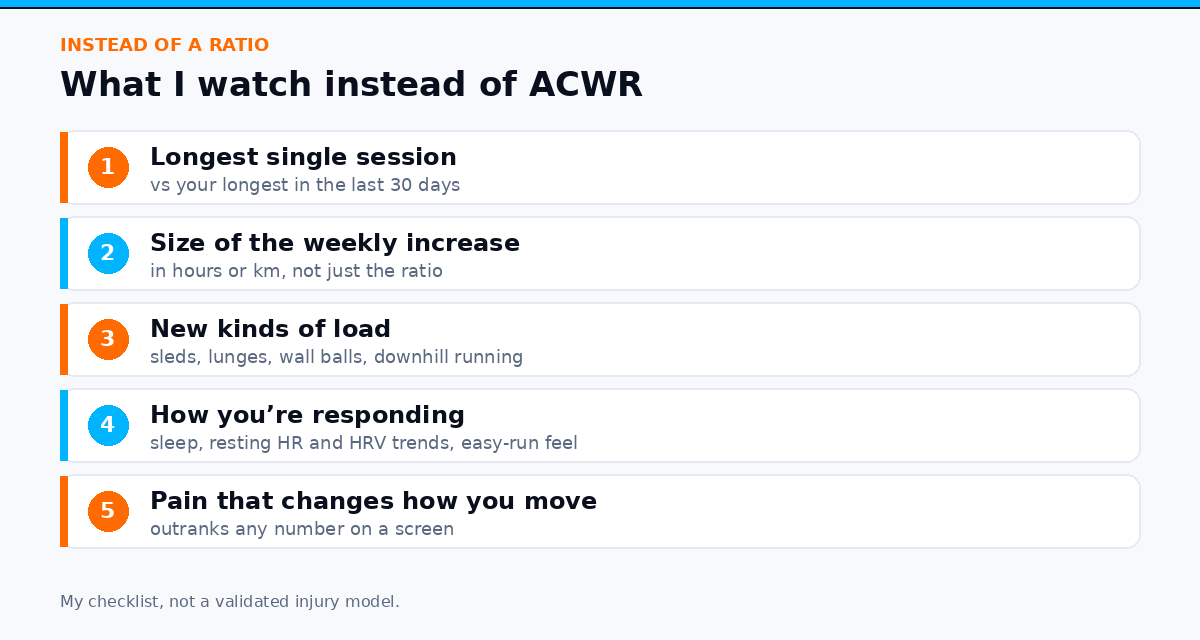
1. Single-session spikes. Compare your longest run this week with your longest run in the last 30 days. That’s the exposure the 2025 runner study linked to higher overuse injury rates. It’s easy to check in any running app, and it catches the classic mistake: the 14 km “easy” run when your longest lately has been 10.
2. The actual size of the weekly increase. Write it in hours or kilometres. “Up 40 minutes” and “up three hours” are different weeks, even if they produce the same ratio.
3. New kinds of load. This is the one I think matters most for HYROX and hybrid athletes, and it’s my opinion rather than something the studies above measured. Heart-rate and duration based load scores can understate work that’s hard on muscles and tendons but doesn’t push your heart rate much: sled pushes and pulls, walking lunges, wall balls, burpee broad jumps, downhill running. Your first HYROX simulation can look like a normal week on a load chart and still leave you sore for days. When something is new to you, count it as a jump, whatever the number says.
4. How you’re responding. Load is what you did. Your response is what it cost. Sleep, resting heart rate and HRV trends over several days, and whether easy runs feel harder than usual, tell you things a ratio can’t. I covered the limits of HRV in HRV and overtraining.
5. Pain that changes how you move. If a niggle changes your stride or your lunge, that outranks any number on a screen. That’s a reason to back off and, if it persists, see a physio or doctor.
If you want the vocabulary for all of this, there’s a short entry on ACWR in the glossary, alongside training load and CTL, ATL and TSB.
Where P247 fits
P247 doesn’t show an ACWR number. It reads your workouts from Apple Health, and from Strava if you connect it, and its weekly report, which is built on fixed rules rather than AI, looks at whether your load rose faster than your recovery signals. That’s the same idea as this post: a change in load means more when you can see how your body is handling it.
This is general information, not medical or physiotherapy advice. If you have pain, an injury or a health condition, talk to a qualified professional before changing your training.