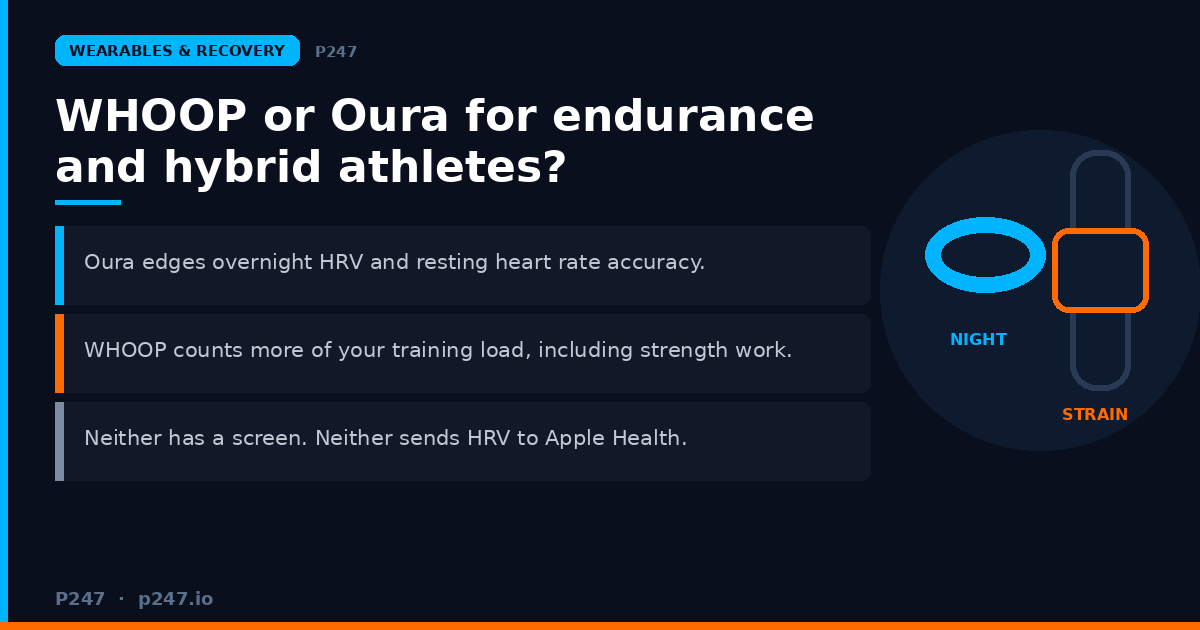
If sleep and overnight recovery data are what you care about most, Oura is the slightly better fit. If you want something that counts your training load, including strength work, WHOOP is the better fit.
That is the short answer. Both come with the same catch, so here it is up front:
- Overnight, Oura has a small edge. In an independent 2025 study against an ECG chest strap, Oura’s overnight HRV and resting heart rate were closer to the reference than WHOOP’s. WHOOP was still rated acceptable.
- For training, WHOOP does more. Its Strain score blends heart rate load with an estimate of muscular load from strength sessions. Oura’s workout measure, Cardio Effort, is based on heart rate and duration.
- Neither one replaces a watch in the session. Neither has a screen, so you cannot see pace, heart rate or intervals mid-session.
- Neither sends its HRV to Apple Health. That matters more than most comparisons admit, and I will explain why below.
I wear an Apple Watch, not a WHOOP or an Oura ring, so this is not a long-term review of either. It is what each company’s own documentation and the independent research say, read by someone who trains for HYROX and a half-marathon and has to make a call about training most mornings.
Two devices built for the same job
People compare WHOOP and Oura because they are trying to do the same thing. Both are built to be worn all day and night, both lean on overnight data, and both give you a morning score that is meant to guide the day. WHOOP calls it Recovery. Oura calls it Readiness.
Neither is a training computer. Neither has a screen. If you run, ride or race to a target pace or heart rate, you will still want a watch, a bike computer or a chest strap paired to something you can see. I covered the ring side of that in Can an Oura ring replace your watch for training?, and the WHOOP side in Garmin or WHOOP for endurance athletes.
So the real question is narrower: which one gives you better overnight data, and which one does a better job of counting what your training cost you?
Overnight accuracy: Oura edges it
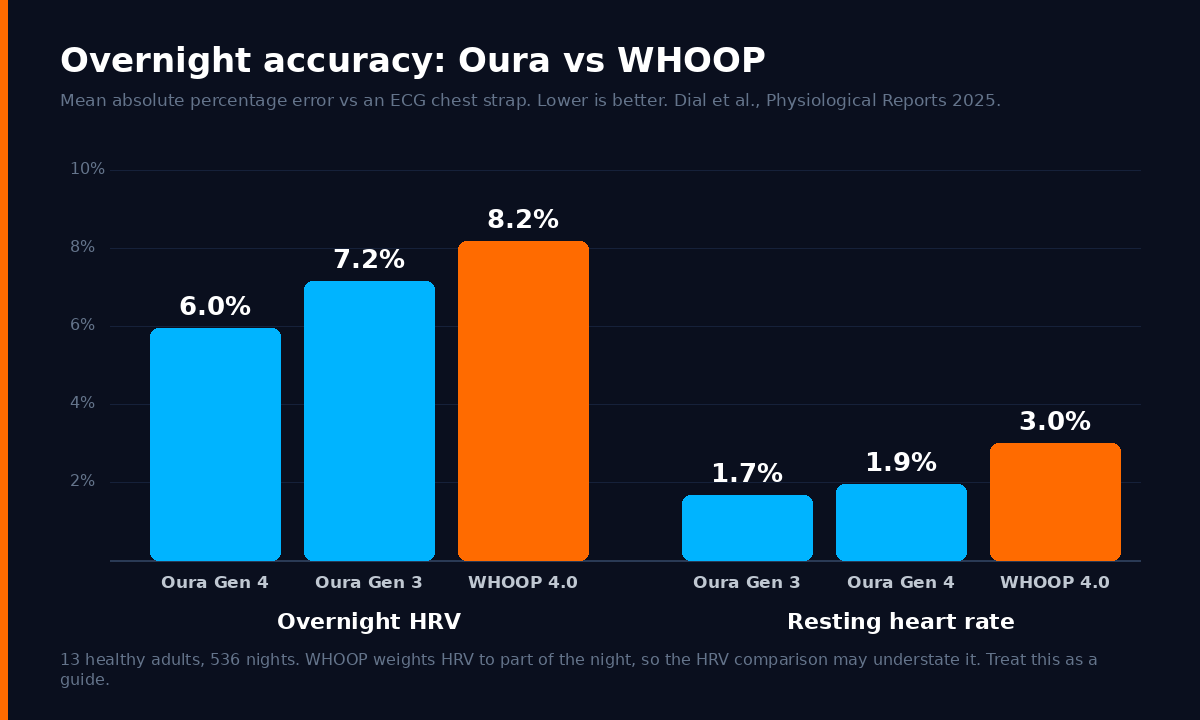
The best head-to-head evidence I can find is Dial and colleagues in Physiological Reports (2025). Thirteen healthy adults slept in an ECG chest strap and several wearables at once, for a total of 536 nights. The devices included Oura Gen 3, Oura Gen 4 and WHOOP 4.0.
Average percentage error against the ECG:
- Overnight HRV: Oura Gen 4 about 6.0%, Oura Gen 3 about 7.2%, WHOOP 4.0 about 8.2%
- Resting heart rate: Oura Gen 3 about 1.7%, Oura Gen 4 about 1.9%, WHOOP 4.0 about 3.0%
The authors summed it up as Oura showing the highest agreement for both, and WHOOP showing acceptable agreement.
Before you treat that as a knockout, the caveats matter:
- Thirteen people is a small group, even across a lot of nights.
- The two devices measure HRV over different parts of the night. A letter to the editor pointed out that WHOOP’s HRV is weighted towards a particular part of the night but was compared with an all-night average from the chest strap. That may have made WHOOP look worse than it really is.
- The WHOOP tested was the 4.0, not the current 5.0 or MG, and firmware changes over time.
My read: if overnight accuracy is the deciding factor, Oura has the better evidence behind it. But the gap is not big enough to make WHOOP’s overnight numbers useless. For HRV, the trend against your own baseline matters far more than any single morning’s number, and both are good enough to show you a trend.
Training load: WHOOP counts more of it
This is where the two really split, and it matters most for hybrid athletes.
WHOOP Strain is a 0 to 21 score that, according to WHOOP’s own explanation, blends cardiovascular strain from heart rate with muscular strain from resistance training, HIIT and bodyweight work. The muscular part comes from its Strength Trainer feature, which estimates load from the volume and intensity of your strength sessions. WHOOP also turns your morning Recovery into a suggested Strain target for the day.
Oura Cardio Effort measures the load on your cardiovascular system during workouts, using heart rate intensity and duration. Oura’s support page says it adds these up across the week and puts you in one of five personal ranges: Light, Fair, Maintaining, Building or Reaching. It needs 14 days of data before you get your first score.
For a marathoner or a cyclist whose training is mostly steady aerobic work, heart rate does a reasonable job of describing load, and the difference between the two is smaller.
For HYROX, it is a different story. A lot of the cost of a HYROX week sits in sled pushes, sled pulls, lunges and wall balls, where heart rate can undersell what the session did to your legs. WHOOP at least tries to count that. Oura’s Cardio Effort, by design, does not. That is a real point in WHOOP’s favour for hybrid athletes.
Two honest qualifications. WHOOP’s muscular strain is an estimate, not a direct measurement of what your muscles went through. And stop-start, grip-heavy work is hard for any optical heart rate sensor. I would not trust either device’s number from a big strength day as the full story.
Cost: different models
WHOOP is membership only. The device is included and you pay yearly. In the US, WHOOP’s membership page lists three tiers: One at US$199 a year, Peak at US$239 and Life at US$359, with Life including the WHOOP MG device. Prices differ outside the US, so check your local WHOOP site.
Oura sells you the ring, and many features need an active membership on top. Even the Apple Health connection, for Gen 3 rings or later, needs an active membership according to Oura’s support page.
Either way, you are signing up for an ongoing cost, not a one-off purchase.
The Apple Health catch nobody mentions
This is the part that changes the decision if you use other apps with your data.
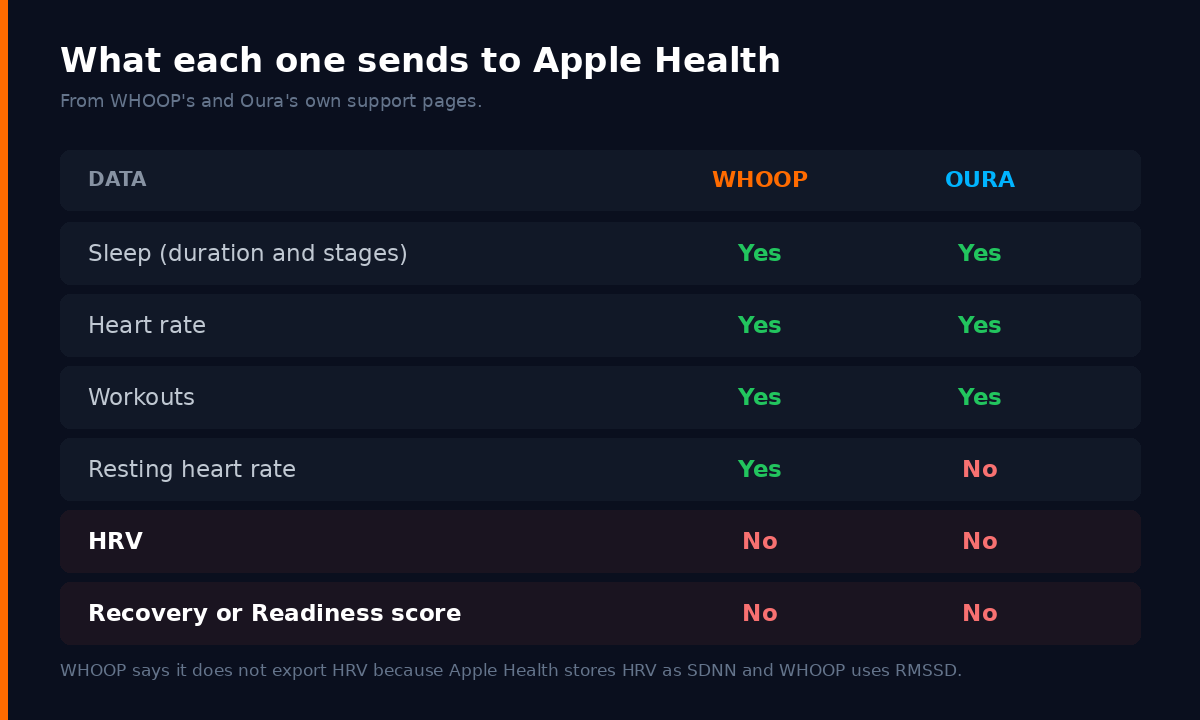
Neither device writes its HRV to Apple Health. WHOOP’s help page explains that Apple Health stores HRV as SDNN while WHOOP calculates it as RMSSD, so it does not export HRV. Oura’s Apple Health export list does not include HRV either.
What they do share is useful but partial:
- Oura sends sleep (including stages), heart rate in one-minute intervals, respiratory rate, steps, active energy and workouts. Resting heart rate is not on its list.
- WHOOP sends workouts, active energy, heart rate, sleep, resting heart rate, respiratory rate and blood oxygen, plus steps if you turn them on.
- Neither list includes the headline score. Recovery and Readiness stay in their own apps.
So any app that reads Apple Health, including P247, gets your WHOOP or Oura sleep and heart rate, but not their HRV. If you also wear an Apple Watch, the watch does write HRV to Apple Health. Just do not compare the watch’s SDNN with your ring or strap’s RMSSD. They are different calculations and the numbers are not meant to match. Pick one device for HRV and compare it only against its own history.
Which one fits which athlete
Marathon, half marathon and triathlon. You will be using a watch for the sessions anyway. If you want the cleanest overnight data and would rather not sleep in a strap, Oura. If you want strain counted and a daily target, WHOOP. Either way, the watch records the session.
Cycling. If you already ride with a head unit and power meter, your sessions are well covered. Choose on overnight data (Oura) or all-day strain (WHOOP).
HYROX and hybrid training. WHOOP, mainly because it at least tries to count strength work. Just do not let a modest Strain number after a heavy sled day convince you that the session was easy.
You mostly care about sleep, and hate wearing anything on your wrist overnight. Oura.
What neither one does
Neither WHOOP nor Oura knows your plan. Neither knows that this is a deliberate overload week, that your key session is Thursday, or that you are three weeks out from a race. A green Recovery or a high Readiness tells you how your body looks this morning. It does not tell you whether this week of training is working.
That is why I keep coming back to the same point: readiness is useful until training context changes the answer. The morning score is one input. The decision still needs your plan, your recent load and how your key sessions are actually going.
The point
Oura is the better overnight sensor, by a modest margin in the best evidence available. WHOOP is the better training load tracker, especially if you lift or do HYROX. Neither one replaces a watch in the session, and neither sends its HRV to Apple Health.
Choose based on the question you most want answered each morning. Then stop expecting the score to make the decision for you.
Whichever you wear, the numbers still need reading together. P247 reads the data your devices put into Apple Health, plus Strava if you choose to connect it. WHOOP and Oura can both share sleep, heart rate and workouts to Apple Health, so they can feed the same picture as your watch. Each morning there is a daily brief with a recovery score built from your own trends, and each week a report on what is working, what is holding you back and what to change. If you want to talk a decision through, you can ask the AI coach.
P247 is available now on the App Store, with Android to follow in 2027. Get it here.
P247 is available now on the App Store. Connect Apple Health and get your first weekly performance report free.