
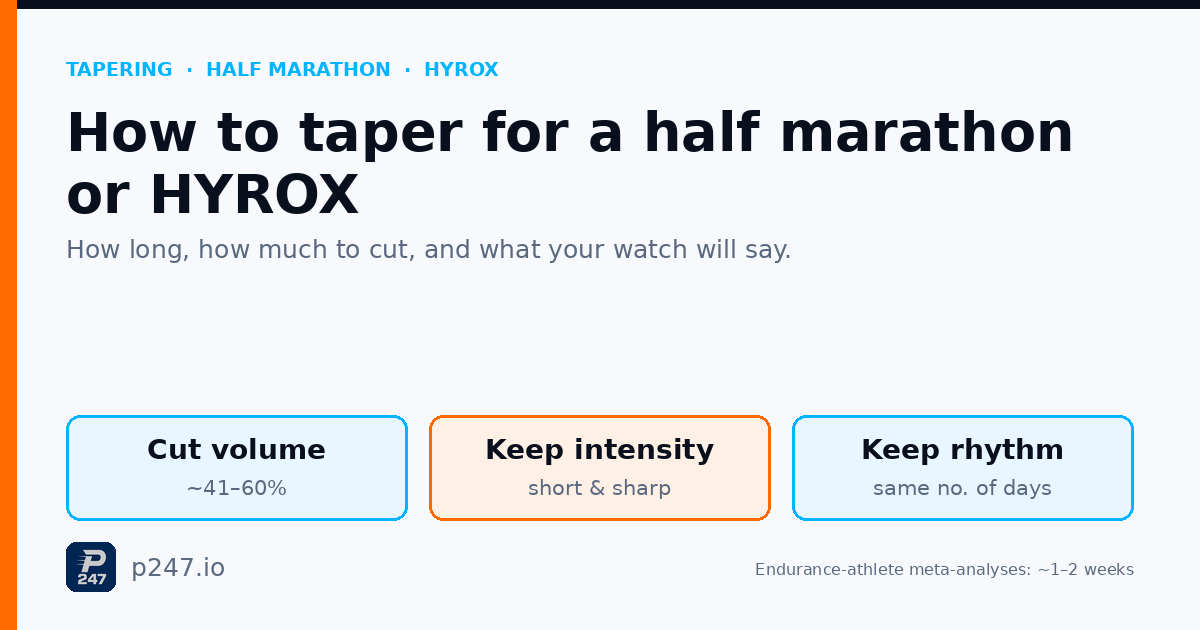
A taper is the short period before a race when you cut your training back so the fatigue clears and the fitness you’ve built can show up on the day. The research on endurance athletes is fairly consistent about the basics: cut volume a lot, keep some intensity, and keep your usual training rhythm. For most people that means one to two weeks, with volume dropping somewhere around 40 to 60 percent below normal by race week.
That’s the easy bit. The harder bits are that almost none of the research looks like a 50-something athlete doing HYROX, and that your watch will often tell you a good taper is a bad idea. Here’s what the evidence actually says, how I’d apply it to a half marathon and a HYROX race, and how to read your data while you do it.
If you want the one-line definition, there’s a glossary entry for tapering.
Short answers
How long should a half marathon taper be? For most recreational runners, somewhere around 7 to 14 days. The pooled research points to roughly two weeks as the sweet spot, but it’s mostly based on shorter races and trained young athletes, so treat it as a range, not a rule. I lean towards the longer end after a big build and the shorter end after a short one, but that’s my judgement, not a finding.
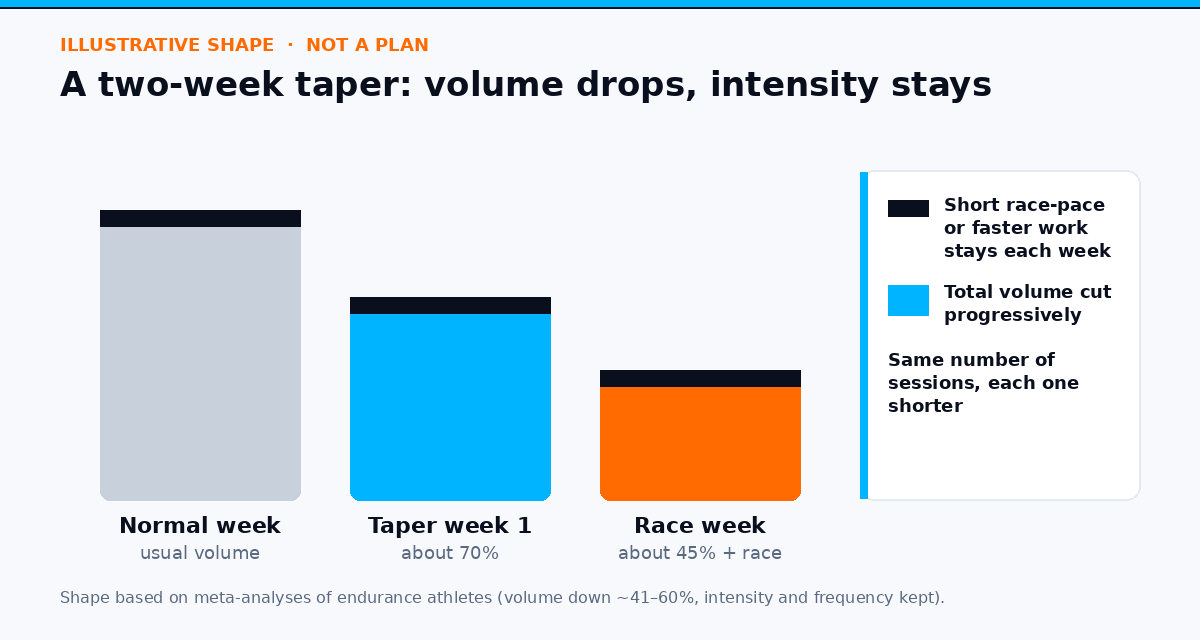
How much should I cut? The meta-analyses found the best results when total training volume came down by about 41 to 60 percent compared with normal. Cutting only a little (20 percent or less) didn’t show a clear benefit.
Should I stop doing hard sessions? No. Both meta-analyses found that keeping intensity was better than dropping it. Keep some short, sharp work at race pace or faster, and cut how much of it you do.
How do I taper for HYROX? There’s no HYROX taper research that I could find, so be honest with yourself that you’re extrapolating. The running part follows the same rules. For the stations, I cut the heavy, muscle-damaging work (sleds, lunges, big wall-ball sets) earliest, and keep short, light practice so the movements still feel normal.
What the research actually says
The best-known paper is a 2007 meta-analysis by Bosquet, Montpetit, Arvisais and Mujika in Medicine & Science in Sports & Exercise. It pooled 27 studies of competitive athletes (mostly swimming, running and cycling). Their conclusion: a taper of about two weeks, where training volume is reduced progressively by 41 to 60 percent, without changing training intensity or frequency, looked like the most effective strategy.
A 2023 systematic review and meta-analysis in PLOS One by Wang, Wang, Gao and Zhong looked only at endurance athletes. It included 14 studies, mostly middle-distance, long-distance and ultra running plus cycling. Tapering improved time-trial performance, and the pattern was similar: cut volume by 41 to 60 percent, keep intensity and frequency, and tapers of up to 21 days helped. Progressive and step tapers both worked. Tapers that came after a deliberate overload block did better than conventional tapers.
The study closest to real recreational runners is a 2021 paper by Smyth and Lawlor in Frontiers in Sports and Active Living. They analysed Strava training data from more than 158,000 recreational marathon runners. “Strict” tapers, where training dropped progressively week after week, were associated with better marathon performance than “relaxed” tapers that didn’t, and tapers up to three weeks were associated with better times than shorter ones. Strict three-week tapers were linked to a median finish-time saving of 5 minutes 32 seconds, or 2.6 percent, compared with a minimal taper.
Now the honest caveats, because they matter:
- The athletes are not most of us. The 2023 review’s participants were aged 17 to 32. I’m in my fifties. Nobody has told me whether masters athletes need a longer or shorter taper, and I’m not going to pretend they have.
- The marathon data is a marathon. The Strava study is observational and about the full distance. A half marathon takes less out of you and usually follows a lighter build, so I wouldn’t copy a three-week marathon taper for one.
- Strength and HYROX are thin. A 2020 review on peaking for powerlifting by Travis, Mujika and colleagues said evidence on peaking protocols for strength and power athletes is lacking, and practitioners rely on trial and error. HYROX is a mixed event with no taper research I could find. You’re borrowing rules from running and lifting.
How I’d taper for a half marathon
This is how I approach it, as an example for a recreational runner who has done a proper build. Adjust it to your own training, and if you have a coach, do what they say.
- About two weeks out: bring weekly running volume down by roughly a quarter to a third. Keep the long run, but noticeably shorter than your longest. Keep one quality session, with fewer reps.
- Race week: total volume around half of normal, not counting the race. One short session early in the week with a few minutes at race pace or slightly faster, so your legs remember what the pace feels like. Everything else easy and short.
- Keep the rhythm. If you normally run four days a week, run four days, just shorter. Both meta-analyses favoured keeping frequency, and in my experience a sudden pile of rest days leaves me feeling flat rather than fresh.
- Strength: keep it, but cut the volume hard and stop anything that leaves you sore. A couple of light sets of your usual lifts is enough. Race week is not when to try a new exercise.
I wrote about building a normal half marathon training and strength week separately. The taper is the opposite job: you’re not trying to build anything any more.
Right now my running is limited by an irritated hip flexor tendon, which is a useful reminder of one more thing: a taper isn’t rehab. If something hurts going into the last two weeks, cutting volume might help it settle, but the taper won’t fix an injury, and race week is not the time to find out whether it’s better. Get it looked at.
How I’d taper for HYROX
A HYROX race is eight 1 km runs with a workout station after each one. The running side tapers like any running: less volume, a little race-pace work, same rhythm.
The stations are where I’d be more careful, because some of them leave you sore for days in a way running at the same effort usually doesn’t.
- Heavy sled pushes and pulls, sandbag lunges and big wall-ball sets: my last proper session of these is around 7 to 10 days out. After that, they’re the first thing I cut.
- Short, light practice: in race week I still touch the movements, a few easy lengths or a handful of reps, so transitions and technique feel normal. It’s practice, not training.
- Engines (SkiErg and rowing): short intervals at race effort are fine early in race week; just do fewer of them.
- Don’t test yourself. A full simulation in the last week tells you nothing you need to know and costs you freshness you do need.
This is my practice and my reasoning, not a tested protocol. If you’ve been through a few HYROX races, your own experience of what leaves you sore is better evidence than anything I can give you.
What your watch will say during a taper
This is where a lot of people get rattled. A good taper reduces your training on purpose, and most wearables are built to notice reduced training.
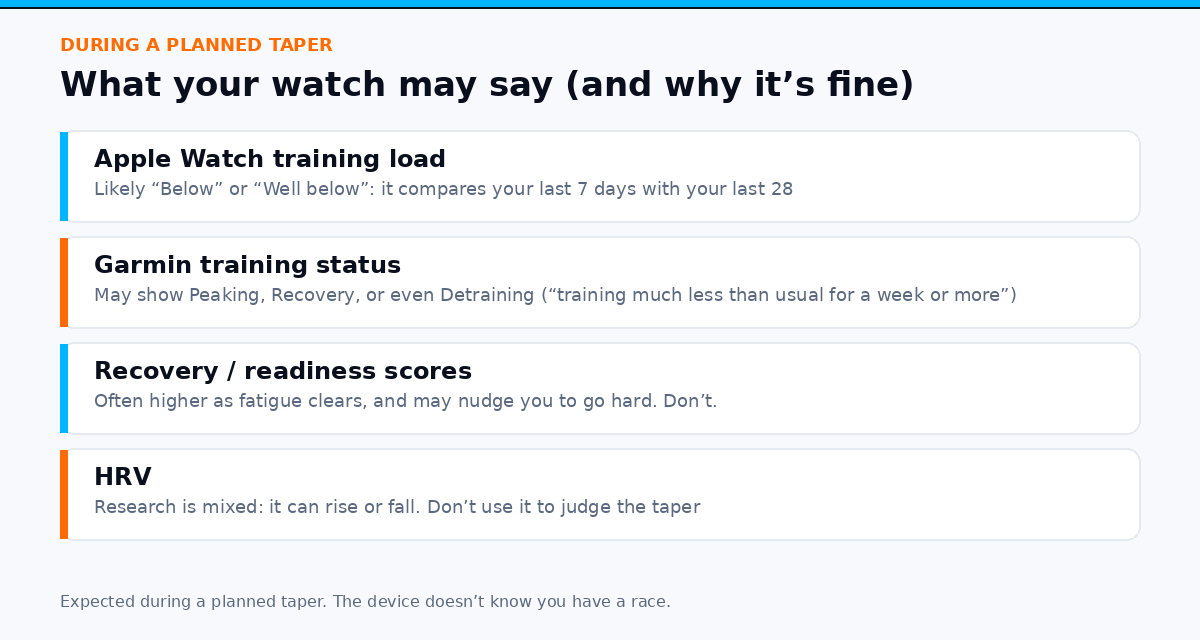
Apple Watch training load. Apple compares your training load for the last seven days with the last 28 days, and labels it well below, below, steady, above or well above. In race week you’ll probably see “below” or “well below”. That’s the point of a taper, not a warning. I explained how the score works in Apple Watch training load explained.
Garmin training status. Garmin’s own manual lists a Peaking status that it describes as “ideal race condition”, where your recently reduced training load lets your body recover. The same page defines Detraining as training much less than usual for a week or more. A proper taper can trigger either, or Recovery. Read the label in context; one word on your wrist doesn’t know you planned this.
Recovery and readiness scores. As fatigue clears, recovery-type scores often rise, and some apps then suggest you go hard. I wrote a whole post on this trap: taper week, when your training load says rest and your recovery score says push. The short version: a high recovery score means you could train hard today, not that you should four days before a race.
HRV. Don’t use HRV to judge whether your taper is working. The research doesn’t give a neat answer. In a study by Bellenger and colleagues, 15 male runners and triathletes did two weeks of heavy training and then a 10-day taper. Their 5 km time-trial times got worse after the heavy block and better after the taper. Standing RMSSD, a vagal HRV measure, went up during the heavy, overreaching block and was still higher than at the start after the taper. Lying-down (supine) RMSSD barely changed. The authors’ point was that a rise in HRV can come from either overreaching or improved performance, so you need other context to interpret it. If you want the background on what your device actually measures, see SDNN vs RMSSD.
What I actually check in race week is simple: am I sleeping, is my resting heart rate in its normal range, do easy runs feel easy, and is anything sore that wasn’t sore last week? If those are fine, I ignore the labels.
Common taper mistakes
- Cutting intensity along with volume. Both meta-analyses found intensity should stay. Short and sharp, just less of it.
- Cutting too little. Dropping 10 or 20 percent and calling it a taper. In the 2023 review, reductions of 20 percent or less didn’t show a significant time-trial improvement.
- Panic training. Feeling flat midweek, seeing “detraining” on your watch, and adding a long run “to be sure”. The fitness is already there; you can’t build more in the last week, but you can arrive tired.
- Changing everything. New shoes, new gels, a new strength routine, a different bedtime. Taper week should look like your normal week, only shorter.
- Ignoring life load. Work, travel and poor sleep in race week all add stress your training log doesn’t show. If you’re flying to your race, expect your numbers to look off for reasons that have nothing to do with fitness.
Where P247 fits
I’m building P247 to read your training from Apple Health and, optionally, Strava, and to keep the load trend and your recovery signals side by side, because a taper is exactly the week when looking at one without the other leads you astray. You can read more at p247.io.
Sources
- Bosquet L, Montpetit J, Arvisais D, Mujika I. Effects of tapering on performance: a meta-analysis. Medicine & Science in Sports & Exercise, 2007.
- Wang Z, Wang YT, Gao W, Zhong Y. Effects of tapering on performance in endurance athletes: a systematic review and meta-analysis. PLOS One, 2023.
- Smyth B, Lawlor A. Longer disciplined tapers improve marathon performance for recreational runners. Frontiers in Sports and Active Living, 2021.
- Travis SK, Mujika I, Gentles JA, Stone MH, Bazyler CD. Tapering and peaking maximal strength for powerlifting performance: a review. Sports, 2020.
- Bellenger CR, Karavirta L, Thomson RL, Robertson EY, Davison K, Buckley JD. Contextualizing parasympathetic hyperactivity in functionally overreached athletes with perceptions of training tolerance. International Journal of Sports Physiology and Performance, 2016.
- Apple. watchOS 11 brings powerful health and fitness insights (training load), 2024.
- Garmin. Training status levels, D2 Mach 2 owner’s manual.
This is general information, not medical or coaching advice. If you have pain, an injury or a health condition, talk to a doctor or physio before race day.