
Resting heart rate is the simplest number your watch gives you. It’s also one of the easiest to misread.
RHR is how many times your heart beats per minute when you’re fully at rest. That part is simple. The tricky parts are that every device defines “rest” a bit differently, that a low number isn’t automatically a good one, and that a high morning is usually a hot room or a couple of beers rather than a training problem.
I’m in my fifties and I train for HYROX and the half marathon, and resting heart rate is one of the few numbers I look at most days. Here’s what it actually tells you, what “normal” means for an athlete, and when I think a rise is worth acting on.
Short answers
What does RHR mean? RHR stands for resting heart rate: beats per minute when you’re calm and still. In wearables it usually means the lowest stable heart rate the device sees during a quiet period, either while you’re awake or while you sleep, depending on the brand.
What’s a normal resting heart rate? The American Heart Association puts a normal adult resting heart rate at 60 to 100 beats per minute, measured sitting or lying down while calm and well. It also says a rate below 60 is common in athletes, and doesn’t always signal a problem.
What’s a good resting heart rate for an athlete? There isn’t one number. Endurance training tends to bring it down over months, so many trained athletes sit below 60. But the useful comparison is with your own usual range, measured the same way, not with a chart or a training partner.
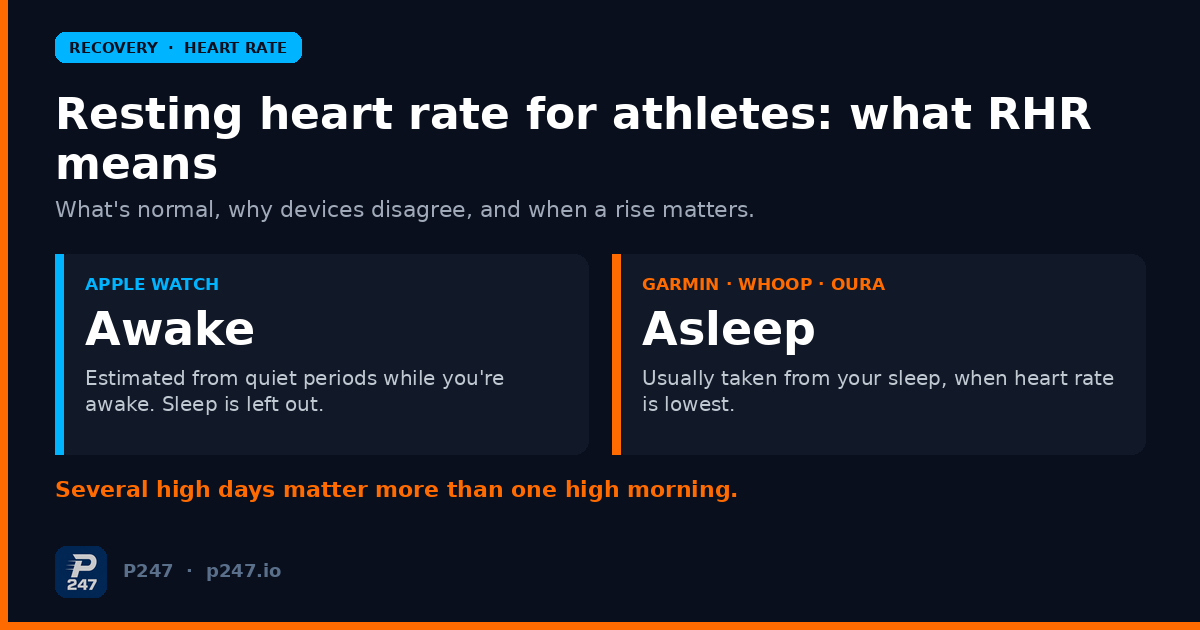
Is resting heart rate the same as sleeping heart rate? No, and this is where most of the confusion comes from. Your heart rate is usually lowest while you sleep. Apple Watch deliberately leaves sleep out of its resting heart rate. WHOOP and Oura base theirs on your sleep, and Garmin’s usually lands there too. More on that below.
Four devices, four different “resting” heart rates
Here’s how each company describes its own number:
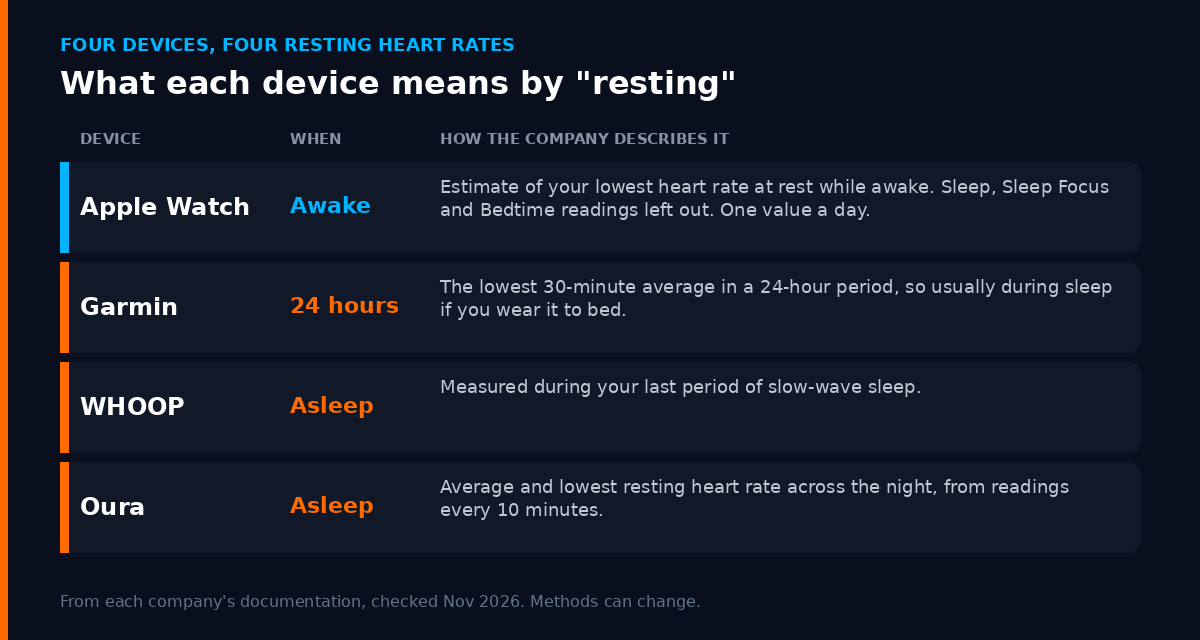
- Apple Watch. Apple’s heart rate white paper says resting heart rate is estimated from background readings in the most inactive parts of the day, leaving out anything recorded during Sleep Focus, scheduled Bedtime or time asleep. It describes the result as an estimate of your lowest heart rate during periods of rest while awake, with one daily value published to Apple Health at the end of the day.
- Garmin. Garmin’s support pages say daily resting heart rate is the lowest 30-minute average in a 24-hour period. If you wear the watch to bed, that will usually fall during sleep.
- WHOOP. WHOOP says it calculates resting heart rate during your last period of slow-wave sleep.
- Oura. Oura reports two numbers: your average resting heart rate across the night and your lowest, from values captured every 10 minutes.
So an Apple Watch resting heart rate will usually sit higher than a sleep-based one from the same person. Oura’s own member data shows how big that gap can be. In its 2026 summary of six million members, the median lowest heart rate during sleep was 55 bpm for men and 59 for women, while the median awake resting heart rate was 70.6 and 73.4. Same company, same members, roughly 15 beats apart, purely because of when it’s measured.
None of these is wrong. They’re answering slightly different questions. The mistake is comparing them with each other, which is the same trap I wrote about with HRV in SDNN vs RMSSD.
One practical tip if you wear more than one device: Apple Health can hold resting heart rate from several sources. It’s worth checking which one is feeding the number you look at (in the Health app, under the data type’s Data Sources & Access), so you’re not reading a watch on Monday and a ring on Tuesday.
And if you want a hands-on version that doesn’t depend on any algorithm, I wrote about taking your own morning resting heart rate in the first 60 seconds after you wake.
Is a lower resting heart rate always better?
Mostly, over the long run, a falling resting heart rate alongside consistent aerobic training is a sign your fitness is heading the right way. But “lower is better” has limits.
International guidelines for reading athletes’ ECGs, published in 2017, treat sinus bradycardia of 30 bpm or more as a normal, training-related finding in asymptomatic, highly trained athletes. The important word there is asymptomatic. A low heart rate with dizziness, fainting or unusual breathlessness is a reason to see a doctor, not a badge.
Two other things worth knowing:
- Age and sex shift the number. In Oura’s member data, the lowest sleeping heart rate was higher in midlife than in younger groups, and women’s numbers sat a few beats above men’s. In my fifties, I don’t expect my number to look like a 25-year-old’s, and I don’t treat that as a fitness problem.
- Unusually low isn’t always good either. Oura itself lowers its Readiness Score when resting heart rate comes in 10 to 15 beats below your usual range, not just when it’s higher. A strange low after a very big effort is still a change from normal.
When a rise actually matters
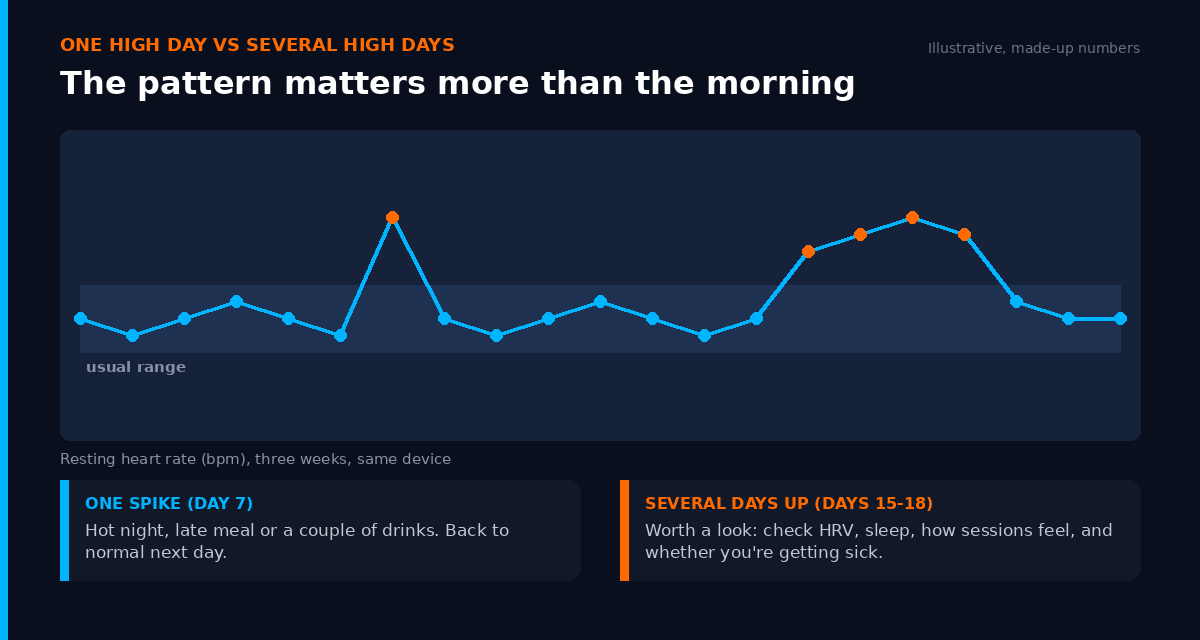
This is the bit that matters for training. A single high reading tells you very little. A rise that holds for several days, especially with other signs, tells you a lot more.
Things that commonly push resting heart rate up for a night or two:
- Getting sick. In a 2020 study in The Lancet Digital Health, Jennifer Radin and colleagues used resting heart rate and sleep data from more than 47,000 Fitbit users and found that weeks with more users showing elevated resting heart rate improved state-level predictions of flu-like illness in the US. That’s population data, not a diagnostic test for you, but it matches what many athletes notice: resting heart rate often creeps up as a bug arrives.
- Alcohol. A 2018 study of 4,098 Finnish employees wearing heart rate monitors found that alcohol raised heart rate and reduced the body’s recovery during the first three hours of sleep, and the effect grew with the amount drunk.
- Heat, stress, travel and late meals. The American Heart Association lists body temperature and emotions among the things that change heart rate. Oura’s support page names illness, late-night eating and lack of sleep. I’ve written separately about why resting heart rate rises on travel days, what flying does to your heart rate and the first hot week of the season.
- Hard training. A heavy block can lift it too, but this is where I’d be careful.
That last point is worth slowing down on, because “my resting heart rate is up, I must be overtrained” is one of the most common conclusions athletes jump to. A 2008 meta-analysis by Laurent Bosquet and colleagues found that short periods of overload training (two weeks or less) produced a moderate rise in resting heart rate in competitive athletes, while longer overload periods didn’t change resting values at all. Their conclusion was blunt: the changes are small enough that they can fall within normal day-to-day variation, so heart rate only means something when you read it alongside other signs and symptoms.
In other words, resting heart rate can flag that something is going on. It can’t tell you what. I covered the HRV side of this in HRV and overtraining.
How I use resting heart rate
1. One device, compared only with itself. I don’t compare my watch with my ring, or my number with anyone else’s. If I change device, I treat it as a fresh start and give it a few weeks.
2. I watch the trend, not the morning. One high reading after a late dinner or a hot night gets ignored. Several days above my usual range gets my attention.
3. I read it with other signals. A higher resting heart rate with lower HRV, worse sleep and sessions that feel harder than they should is a pattern. Resting heart rate on its own is just a number. If you’re new to HRV, there’s a short glossary entry on HRV and why the trend matters more than today’s number.
4. A rise with symptoms is an illness question first. Sore throat, feeling flat, heart rate up for a few days: I swap intensity for easy work or rest, and if it doesn’t settle or I feel unwell, I’d rather ask a doctor than push through.
5. I keep it in its lane. Resting heart rate also feeds into heart rate zone methods that use heart rate reserve, alongside your max heart rate. For that job I want a stable, typical value, not this morning’s reading.
For the short definition, see the resting heart rate glossary entry.
Where P247 fits
P247 reads your health data from Apple Health, plus your workouts from Strava if you choose to connect it. So the resting heart rate it sees is whatever is in Apple Health, which for most people is Apple Watch’s awake-only estimate.
For heart rate calculations, P247 uses a rolling 30-day median of your morning readings, so one odd morning doesn’t move it much. Resting heart rate is also one input to P247’s daily recovery score, which is built on fixed rules rather than AI. To be upfront about a limitation: in that score it’s currently rated against a fixed reference value, not against your own baseline, which is the approach I’ve argued for in this post. The weekly report does look at HRV and resting heart rate together when judging whether recovery kept up with training.
I’m still building P247 and writing up what I learn along the way. If that’s useful, you can read more at p247.io.
This is general information, not medical advice. Consumer wearables aren’t diagnostic devices. If your heart rate is unusually high or low for you, especially with symptoms such as chest pain, dizziness, fainting or shortness of breath, see a doctor.